A patient entering a hospital brings with them expectations that go far beyond the quality of the medical visit. They expect to find the wards without getting lost, not to wait in line for an hour at the counter, and to receive clear answers before and after the service. In short: they expect an experience.
This experience is called the Patient Journey —the complete patient journey from access to the facility to the post-care phase. And in Italy, today, it has become a pressing issue not only for reasons of perceived quality, but also for specific regulatory requirements and funding opportunities related to the National Recovery and Resilience Plan (PNRR).
According to the Digital Innovation in Healthcare Observatory at the Polytechnic University of Milan, 67% of Italian healthcare directors identify patient experience as a strategic priority for the next three years. However, less than 30% of facilities have integrated digital systems across the entire patient journey.
In this guide, we analyze what the patient journey is, the critical phases to manage, how digital technology is transforming every touchpoint, and—specifically—which Kiosk solutions enable an integrated, efficient, and measurable patient journey.
Index
Definition of the Patient Journey
Examples of Patient Journeys
The 5 critical phases of the patient journey: problems and solutions
The Italian context: PNRR and the digitalization of healthcare
Integration is the real difference: an ecosystem, not isolated solutions
Measurable benefits for Hospital Management
FAQ – Frequently Asked Questions about the Patient Journey in Hospital
Conclusions: the patient journey is not a project, it is a responsibility
What is the Patient Journey?
The Patient Journey is the sum of all interactions a patient has with a healthcare provider: from the perception of the need for care to post-treatment follow-up. It’s not limited to the visit or admission, but includes every touchpoint—physical, digital, telephone—before, during, and after the service is provided.
Unlike traditional clinical quality assessments, the patient journey also considers the experiential dimension: how the patient perceives the wait, orientation, communication, and the simplicity of administrative procedures. It is this perception that determines final satisfaction and, consequently, the facility’s reputation.
For hospital management, mapping and optimizing the patient journey means intervening on two distinct but interconnected levels:
- the operational level — reduce waiting times, simplify flows, better distribute resources;
- the experiential level — building a coherent, accessible path that is perceived as efficient by the patient and their family members.
Examples of Patient Journeys
To better understand the concept, let’s consider a practical example.
Imagine a patient who experiences persistent chest pain and decides to seek medical attention.
Their patient journey will begin with an online search for information about symptoms, followed by a visit to their primary care doctor, diagnostic tests, and potentially a hospital stay for treatment and monitoring.
After discharge, the patient may face follow-up visits and long-term therapies.
The 5 critical phases of the patient journey: problems and solutions
The hospital patient journey is divided into five main phases. Each presents specific challenges that digital technology can measurably address.
Let’s analyze each phase in detail.
Phase 1 — Pre-access: booking is already part of the experience
The patient journey begins before the patient even steps foot in the hospital. Online research, appointment scheduling, confirmation communications, and reminders all contribute to the first impression of the facility.
The most common problem at this stage is fragmentation: congested telephone CUPs, an unintuitive online portal, and a lack of automatic reminders. The result is a high no-show rate—over 20% in some facilities—which generates significant direct and indirect costs.
LEARN MORE
Kiosk Buk — a multi-channel online booking system that integrates a calendar, automatic confirmations, SMS/email reminders, and cancellation management. It reduces no-shows and reduces the load on the CUP.
Phase 2 — Access and welcome: the first physical contact is crucial
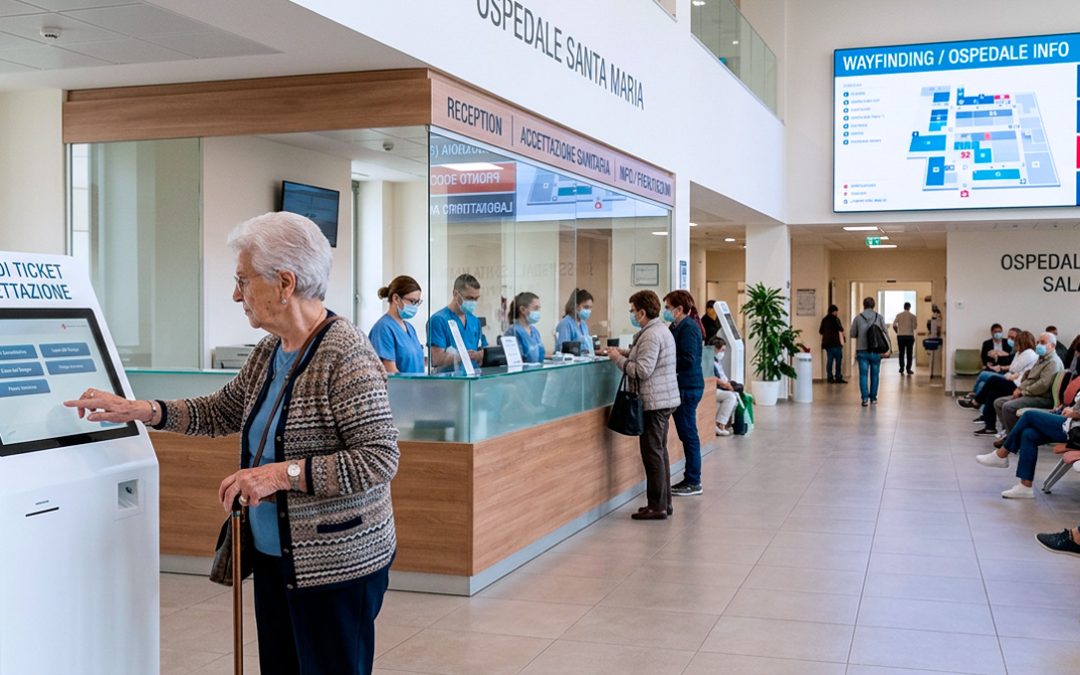
Admission to the hospital is the most stressful moment for patients. They find themselves in an unfamiliar, often anxious environment, needing to find their way around and complete administrative procedures as quickly as possible.
At this stage, three distinct problems are concentrated, requiring three distinct solutions:
- Queues at the counters. Queues at the check-in counters generate waits that are perceived as unfair and demotivating.
- Orientation. Orientation in large facilities, spread across multiple floors and pavilions, causes stress and delays.
- Entrance registration. Entrance registration is often still paper-based, posing security and inefficiency risks.
LEARN MORE
Kiosk Hydra — a queue and flow management system that distributes patients to available counters, shows real-time waiting times on digital displays, and optimizes staff workload.
LEARN MORE
Kiosk Wayfinder — an interactive digital wayfinding system that guides patients throughout the facility through touch screen kiosks, interactive maps, and real-time updateable digital signage.
LEARN MORE
Kiosk Varco — a GDPR-compliant digital entry registration system that replaces paper registers and enables real-time access control.
Stage 3 — Waiting: Perceived time is different from real time
The waiting room is one of the most critical touchpoints in the patient journey. International studies show that perceived waiting time—what patients remember as “the wait”—can be significantly reduced through real-time information and relevant content on screens.
A patient who is informed about how long they will have to wait and why, and who in the meantime receives useful information (health advice, updates on services, directions to departments), experiences the wait in a radically different way than someone who sits in silence with no guidance.
LEARN MORE
Digital Signage Kiosk — a network of digital displays for waiting rooms that displays queue status, clinical information, and facility communications in real time. It reduces the perception of wait time and improves the atmosphere in the room.
Phase 4 — Visit and assistance in the facility: monitor every point without increasing staffing
In a large hospital—spread across multiple wards, floors, and departments—guaranteeing immediate care in every area with physical staff is operationally impossible. Corridors, transit areas, and specialist departments during night shifts: there are always unattended areas where a patient or visitor could encounter difficulties.
This criticality generates negative experiences that the patient memorizes as a symbol of the entire structure: “no one helped me”, “I didn’t know where to go”, “I couldn’t find anyone to ask”.
LEARN MORE
Kiosk Live Hospital — a virtual help desk platform with video calling that allows patients and visitors to contact a remote operator in real time via touch screen kiosks located in corridors and unattended areas. The operator answers from any location in the facility. The interface is designed for users with limited mobility, the elderly, and those with limited digital capabilities.
Phase 5 — Post-care: Structured feedback closes the loop
The moment of discharge or leaving the facility is the last impression a patient will take with them. It’s also the moment they’re most likely to express their opinion on their experience—positive or negative.
Collecting this feedback in a structured, immediate, and aggregated way is essential for two reasons: to continuously improve internal processes, and to demonstrate to regulatory authorities and citizens that the organization measures and addresses perceived quality.
LEARN MORE
Kiosk Emoticon — an instant survey system based on emoticons and smileys that measures patient satisfaction upon exit in seconds. The data is aggregated into real-time dashboards, allowing management to identify areas for improvement and take rapid action.
The Italian context: PNRR and the digitalization of healthcare
The digitalization of the patient journey in Italy is not just a strategic choice—it is a concrete funding opportunity. The National Recovery and Resilience Plan (PNRR) has dedicated Mission 6 to healthcare, with approximately €15.6 billion allocated to reform and strengthen the national healthcare system.
Among the planned investments, those related to the digitalization of hospital processes and improving the patient experience are priorities. Specifically:
- Investment 1.2 involves the digital transformation of the NHS, including booking systems, telemedicine, and patient flow management;
- Investment 1.3 is dedicated to strengthening local care and digitalizing access processes;
- National targets require facilities to document improvements in patient experience as an outcome indicator.
Practical implication
For healthcare directors and facility managers, this means that the adoption of digital technologies for the patient journey can no longer be postponed: it is a condition for accessing funds and for meeting the reporting targets set by the Plan.
Kiosk supports healthcare facilities in the design and implementation of these systems, with certified solutions that can be integrated with existing IT infrastructure (HIS, CUP, hospital ERP) and are suitable for public procurement procedures through Consip and MePa.
Integration is the real difference: an ecosystem, not isolated solutions
The weakness of most hospital digitalization projects isn’t technology—it’s fragmentation. An online booking system that doesn’t communicate with the queue management system. A wayfinder that doesn’t know which clinics are open in real time. A feedback system that collects data but doesn’t share it with management in a usable way.
Real value is achieved when systems communicate with each other and form a coherent ecosystem throughout the patient journey. Here’s how it works in practice with Kiosk solutions:
An example of an integrated path
Patients book their appointment via Kiosk Buk and receive a confirmation with a QR code. On the day of their appointment, they register at a Kiosk Varco kiosk with their QR code at the hospital entrance. The Kiosk Hydra system automatically directs them to the correct queue, and the display in the waiting room shows their number and estimated time. If they need guidance, the Kiosk Wayfinder kiosk shows them the route. If they’re in an unattended area and need assistance, they use the Kiosk Live Hospital kiosk to video call an operator. Upon exiting, a Kiosk Emoticon kiosk asks them to rate their experience for three seconds. Hospital management monitors everything via integrated dashboards.
This isn’t a futuristic scenario. It’s the type of project Kiosk designs and implements with Italian healthcare facilities, always starting with an analysis of existing flows and building solutions tailored to the organization.
Measurable benefits for Hospital Management
Patient journey optimization isn’t an investment in “soft values.” It produces measurable results across operational, financial, and reputational indicators that management can share with the board and report to funding agencies.
In addition to operational KPIs, the adoption of digital systems for the patient journey has a direct impact on:
- Compliance. Regulatory compliance: compliance with Legislative Decree 81/08 for access traceability, GDPR for visitor and patient data management.
- Accreditation. JCI/ISO Accreditation: Satisfaction tracking and flow management systems are explicit requirements in international accreditation processes.
- Reputation. Online reputation: a positive patient journey reduces negative reviews on portals like Dove e Come and on Google Maps, with a direct impact on patient choice.
FAQ – Frequently Asked Questions about the Patient Journey in Hospital
What is the Patient Journey in healthcare?
The Patient Journey is a patient’s complete journey through the healthcare system: from the perception of the need for care, to booking, to accessing the facility, to the visit or hospitalization, up to post-treatment follow-up. It includes every physical and digital interaction with the facility. Optimizing it means addressing every touchpoint to reduce stress, shorten wait times, and improve overall patient satisfaction.
Why is the Patient Journey important for a hospital?
Because patient satisfaction depends not only on the clinical quality of care, but on the quality of the entire experience. A facility with excellent medical quality but a poorly managed patient journey receives negative reviews, loses patients, and struggles to attract qualified staff. Furthermore, accreditation systems (JCI, ISO 9001) and AGENAS guidelines require systematic measurement of patient experience as a quality indicator.
What technologies improve the patient journey in hospital?
The key technologies are: online booking systems (to reduce no-shows and simplify access), queue management systems (to reduce waiting times at counters), digital wayfinding systems (for orientation within the facility), remote video assistance (to monitor unmanned areas), digital signage (to provide information in the waiting room), and instant surveys (to collect exit feedback). The value is multiplied when these systems are integrated with each other.
What does the PNRR provide for hospital digitalization?
Mission 6 of the PNRR has allocated approximately €15.6 billion to healthcare. Investments under M6C1 (proximity care) and M6C2 (NHS innovation) explicitly include the digitalization of patient access, booking, and management processes. Facilities that adopt digital patient journey systems are eligible for this funding and must document the results achieved in terms of improved patient experience.
How is patient satisfaction measured in hospital?
The main methods are: instant surveys with emoticons or smileys (immediate outgoing feedback), NPS (Net Promoter Score) questionnaires administered via SMS/email after the visit, CSAT (Customer Satisfaction Score) collected via kiosks or tablets in the waiting room, and online review analysis. The most effective method for real-time data collection is the physical instant survey, which achieves response rates between 65 and 85%, compared to 5-15% for questionnaires sent via email.
How much does it cost to digitize the patient journey in a hospital?
The cost depends on the size of the facility, the number of touchpoints to be managed, and the level of integration with existing information systems. Kiosk works on modular projects: you can start with a single system (for example, queue management) and gradually expand the ecosystem. For facilities that access PNRR funds or regional calls for proposals, part of the investment can be covered by public funding. The first step is always an analysis of existing flows, which Kiosk offers in a consultancy format.
Do Kiosk systems integrate with existing hospital management software?
Yes. Kiosk solutions are designed with open architecture and support REST API integration with leading HIS (Hospital Information Systems), CUP software, and accreditation management platforms. The Kiosk technical team manages the integration project in collaboration with the facility’s data center.
Conclusions: the patient journey is not a project, it is a responsibility
Optimizing the patient journey isn’t optional for Italian healthcare providers that want to remain competitive and compliant. It’s a responsibility to patients—who deserve an experience worthy of the clinical quality they receive—and to the organization, which can function better with more predictable flows, intelligently distributed resources, and data for decision-making.
Technology alone isn’t enough. You need a partner who can design it based on the facility’s real-world flows, integrate it with existing systems, and support its adoption by staff. Kiosk does just that, with 30 years of experience in healthcare, administrative, and corporate environments.

Talk to a Kiosk Consultant
Tell us about your project