A utility queue management system is a software platform for digitally managing queues at counters for companies that provide local public services—water, gas, electricity, waste management, and transportation. It allows you to organize user flows, sort by service type, integrate online booking, and monitor the quality KPIs required by ARERA regulations.
Italian utilities and multi-utilities manage millions of counter accesses every day: billing, connections, complaints, direct debits, and contracts. In many cases, queue management is still entrusted to outdated or unstructured systems. This guide analyzes the specific challenges of the sector and how a professional queue management system can solve them.
Utilities and multi-utilities in Italy: a sector with 3,600 companies
There are approximately 3,600 Italian utilities—companies that manage water, gas, electricity, waste, and local services—the vast majority of which are owned by local public bodies (municipalities, provinces, metropolitan cities). This is a highly diverse network of companies: from large national energy groups to regional multi-utilities to small municipal water and waste collection companies.
What almost all of them have in common is the need to operate a physical service desk—often multiple locations—where citizens go for administrative procedures related to the services provided. And these desks are almost always among the most critical points of contact with the public in terms of queue management.
The specific problem of utility counters
A utility counter is not the same as a bank counter or a pharmacy counter. It has its own characteristics that make queue management particularly complex:
| Feature | Impact on management code |
|---|---|
| Highly seasonal flow | Peaks in flow at bill due dates, bonus or contribution request periods, and tariff migration campaigns |
| Heterogeneous services | The same office handles connections, complaints, domiciliations, ISEE procedures, social benefits — services with very different processing times |
| Vulnerable users | High presence of elderly people, users with language or digital difficulties who require longer assistance times |
| ARERA obligations | Many utilities are subject to ARERA regulation with minimum standards on waiting times and response times at the counter. |
| Multi-site networks | Companies with multiple local offices require centralized management and comparative reporting. |
| Systems integration | Data collected at the counter must flow into the company’s back-office systems via APIs or dedicated connectors. |
Why a traditional queue management system isn’t enough
Many utilities have installed first-generation queue management systems over time—physical number dispensers, manual call displays, or low-end cloud-based systems. These systems solve the basic problem (giving users a number), but they don’t address the specific challenges of the industry.
A basic system is unable to:
- Automatically sort by service type with differentiated priorities
- Integrate online booking with physical queue management
- Provide real-time reporting for multiple locations
- Monitor the quality KPIs required by regulations
- Manage priority users (elderly, disabled, users with appointments) without manual intervention
Industry data:
Utilities subject to ARERA regulation must meet commercial quality standards, including maximum waiting times at counters. A queue management system with analytics allows you to monitor these KPIs in real time and produce the necessary reporting for regulatory compliance.
Kiosk Hydra is designed to meet the specific needs of utilities and multi-utilities: multi-site cloud architecture, priority management by service type, and advanced analytics that support compliance with the commercial quality standards required by industry regulations.
The citizen’s journey is tracked and monitored at every stage: from booking an appointment to calling the counter, up to surveying satisfaction with the service received.
How a utility queue management system works
A professional system like Kiosk Hydra structures the flow of a utility counter as follows:
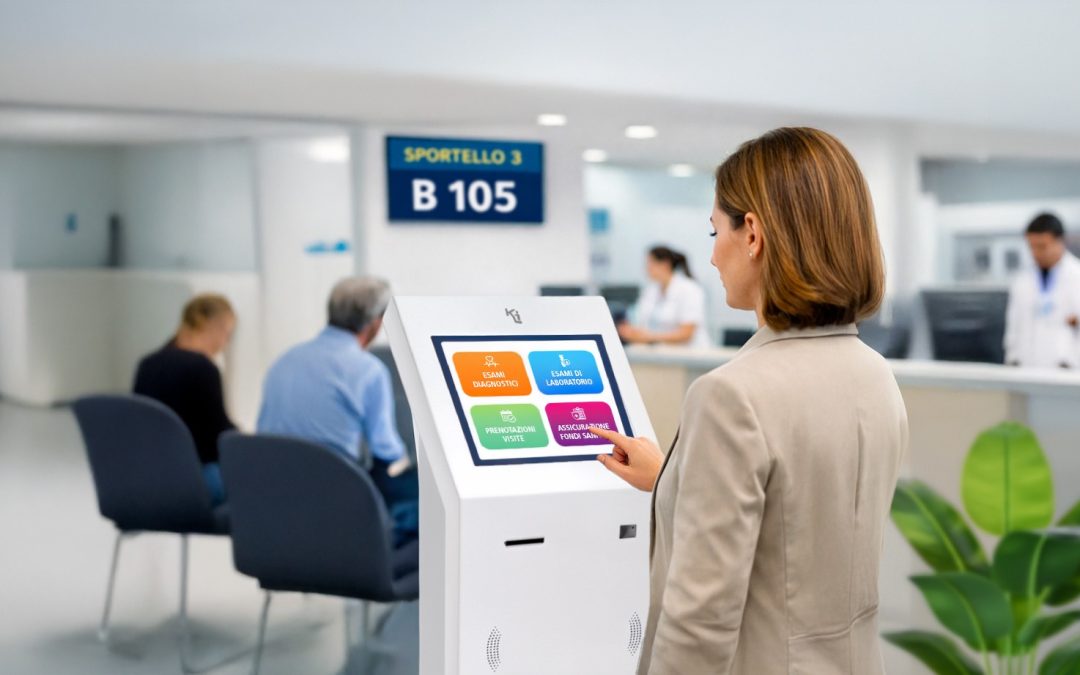
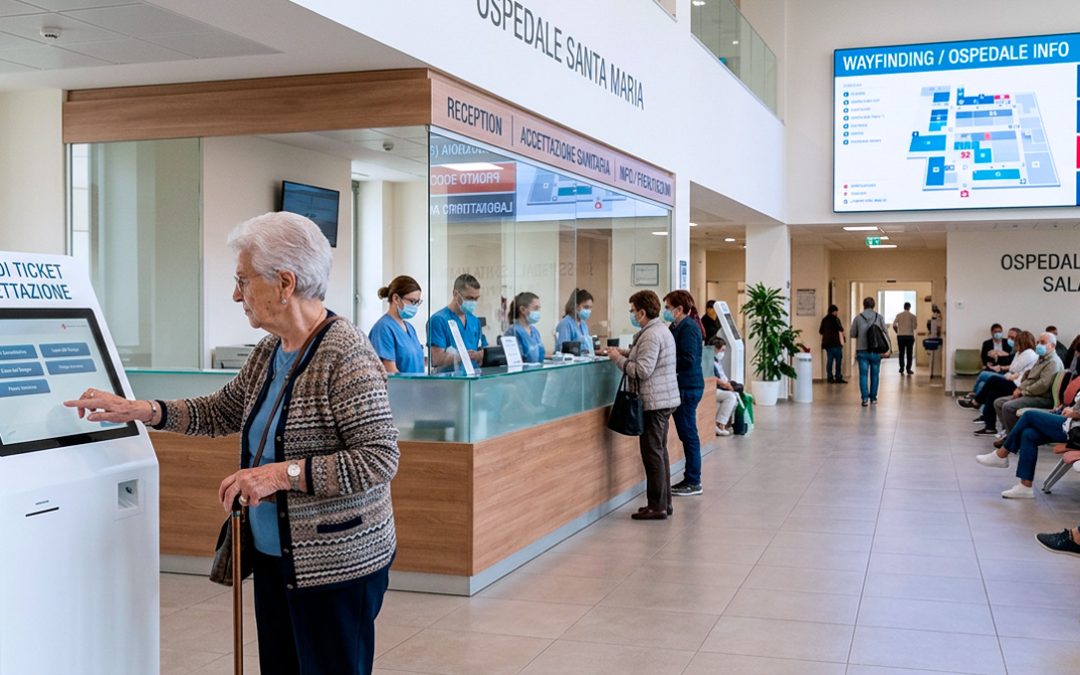
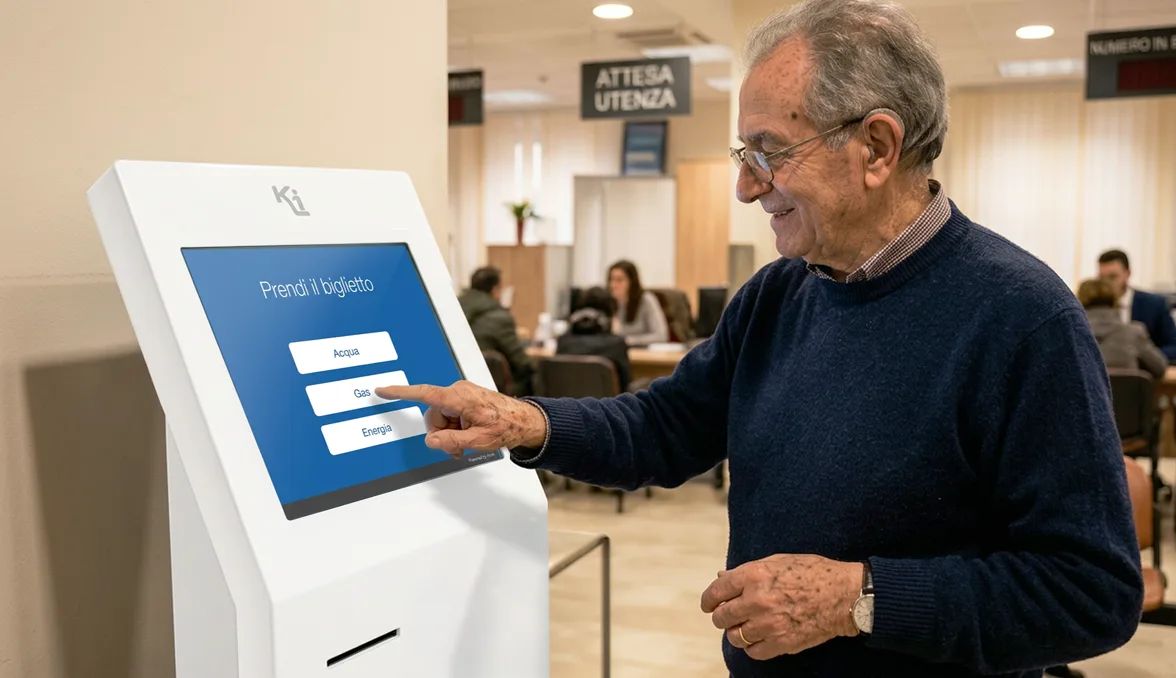
- Welcome — The citizen arrives at the counter and selects the service on the touchscreen kiosk (connection, complaint, bill, bonus, information). The system assigns a ticket with a defined priority.
- Advance Booking — With the integrated Kiosk Buk, the citizen can book an appointment online before going to the counter, eliminating the physical wait for those who book.
- Informed Waiting — Displays in the waiting room show estimated times and the number of people in line. Integrated digital signage provides information on promotions, service alerts, or ongoing campaigns.
- Intelligent routing — The system automatically routes each ticket to the appropriate counter for that service, optimally distributing the workload among operators.
- Reporting — At the end of the day, the manager accesses data: average waiting times, service times by type, most efficient operators, peak traffic, and comparisons between locations.
Multi-location management: added value for branch networks
Utilities with multiple branch offices have needs that go beyond a single location. A centralized cloud system like Kiosk Hydra allows you to:
- Manage the configuration of all branches from a single dashboard
- Compare performance across different locations
- Identify locations with operational issues or abnormal wait times
- Apply updates and changes to service rules across the entire network simultaneously
- Produce aggregated reports for management and regulators
For companies managing 5, 10, or 20 branches distributed across the country, this level of centralized control is impossible with independent systems per location.
→ Learn more about Kiosk Hydra, the queue management software for utilities and municipal companies
Online booking: reducing physical queues at utilities
One of the most common problems at utility counters is the concentration of access at certain times or periods of the year. Online booking distributes flows predictably, with measurable benefits:
- Reduction of spontaneous queues during peak times
- Ability for users to choose the most convenient time
- Elimination of waiting times for those who have booked
- Better staff scheduling at the counter
- Reduction of no-shows thanks to automatic reminders via SMS and email
The integration between Kiosk Buk (online booking) and Kiosk Hydra (counter queue management) creates a continuous flow: online bookings are automatically transformed into priority tickets in the queue management system, without manual intervention.
Utility and Municipal Sectors: specific use cases
Water and Water Services
Water companies manage service desks for connections, transfers, bill complaints, and rate reduction procedures based on income levels. Peak traffic is related to payment deadlines and utility bill update campaigns. Online booking significantly reduces wait times and improves the perceived quality of service.
Gas and Energy
Energy utility offices handle a mix of commercial and administrative procedures: new contracts, transfers, rate complaints, activation of social benefits, and ISEE procedures. The variety of services requires sorting by expertise and processing times vary greatly depending on the type of procedure.
Waste Collection and Urban Hygiene
Waste collection companies operate offices for the distribution of waste sorting kits, TARI (Tax on Waste) account changes, and service complaints. They are among the utilities with the highest number of elderly and vulnerable users, who require simple interfaces and longer support times.
Local Public Transport
Local public transport companies operate offices for season tickets, refunds, and facilitated procedures. Queue management is critical during annual season ticket renewal periods and on expiration days for monthly passes.
ARERA compliance and commercial service quality
Utilities subject to ARERA (Regulatory Authority for Energy, Networks and the Environment) regulation must meet commercial quality standards that include indicators on response times at the service desk.
A queue management system with advanced analytics allows you to:
- Monitor compliance with time standards in real time
- Generate the reports needed for periodic audits
- Identify critical issues before they become non-compliant
- Document performance for reporting to regulatory bodies
Frequently Asked Questions
What is a utility queue management system and how does it work?
A utility queue management system is a software and hardware platform that digitally manages user flows at the counters of public service providers. It works like this: the user arrives at the counter, selects the desired service on a touch-screen kiosk (connection, complaint, bill, social security bonus), receives a digital or paper ticket, and waits for the call on the display. The system automatically directs each request to the appropriate counter, records wait and service times, and produces real-time operational reports.
What are the most common problems in managing queues at utility counters?
The most frequent problems at utility counters are: peaks in traffic concentrated around bill due dates or during tariff campaigns, mixed user bases with highly variable service times between requests, a high presence of elderly or frail users requiring extended assistance, the inability to monitor the quality KPIs required by ARERA regulations, and a lack of centralized visibility for those managing multiple counters across the territory. The combination of these factors makes basic queue management systems insufficient.
How does online booking for a utility counter work?
With an integrated system like Kiosk Buk + Kiosk Hydra, citizens access the utility’s booking portal, choose the type of request, select the available date and time slot, and receive a confirmation with a reminder via SMS or email. On the day of the appointment, customers present themselves at the counter with their booking code: the system recognizes the ticket as a priority and automatically inserts it into the queue management flow, avoiding spontaneous waiting in line. For the utility, the benefit is the predictable distribution of flows and the reduction of sudden peaks.
Should a queue management system for utilities integrate with the company’s CRM?
It depends on the needs. In many cases, a standalone queue management system with its own reporting is sufficient. However, when it is necessary to connect counter data to the management system (e.g., identifying users by customer code, updating the status of the case), Kiosk Hydra supports integration via REST API with the main CRM and management systems in the utility sector.
How do you manage elderly or digitally impaired users?
Kiosk kiosks can be configured with simplified, high-contrast interfaces, large text, and minimal navigation flow. For utilities with a high number of vulnerable users, it’s possible to configure an assisted reception process where front-office staff helps users select the service they need, while maintaining all the benefits of a digital management system.
How long does it take to install a queue management system in a utility?
For a single counter with a standard configuration, installation times are generally 1-2 days. For multi-site networks with software integrations, the project requires a longer analysis and configuration phase. Kiosk provides comprehensive support, from flow analysis to installation and staff training.
Can the system handle the seasonal peaks typical of utilities?
Yes. Kiosk Hydra allows you to configure different management rules for different time slots and times of year—for example, increasing the priority of certain types of service during peak periods, or automatically activating additional counters when certain queue thresholds are exceeded.
How is the ROI of a queue management system measured in a utility?
The main indicators are: reduction in average service time per case, increase in the number of cases handled per operator per hour, reduction in complaints related to waiting times, and improvement in ARERA commercial quality indicators.
In multi-site contexts, this also includes a reduction in supervision costs and the ability to quickly identify locations with operational issues.
Further reading
If you’d like to delve deeper into this topic, we also recommend reading these other articles.
| GUIDE Queue elimination system: complete guide |
GUIDE Queue management: complete guide |
| GUIDE How to choose a queue management system |
Pricing How much does a queue elimination system cost |
| Operational How to reduce no-shows |
Enterprise Multi-site queue management |
| Product Kiosk Hydra — queue management platform |
Product Kiosk Buk — online appointment booking |

Are you considering a queue management system for your utility or municipal company?
Each counter has different flows, services, and regulatory constraints. Kiosk consultants analyze your structure and propose the most suitable configuration — from a single location to a multi-branch network.