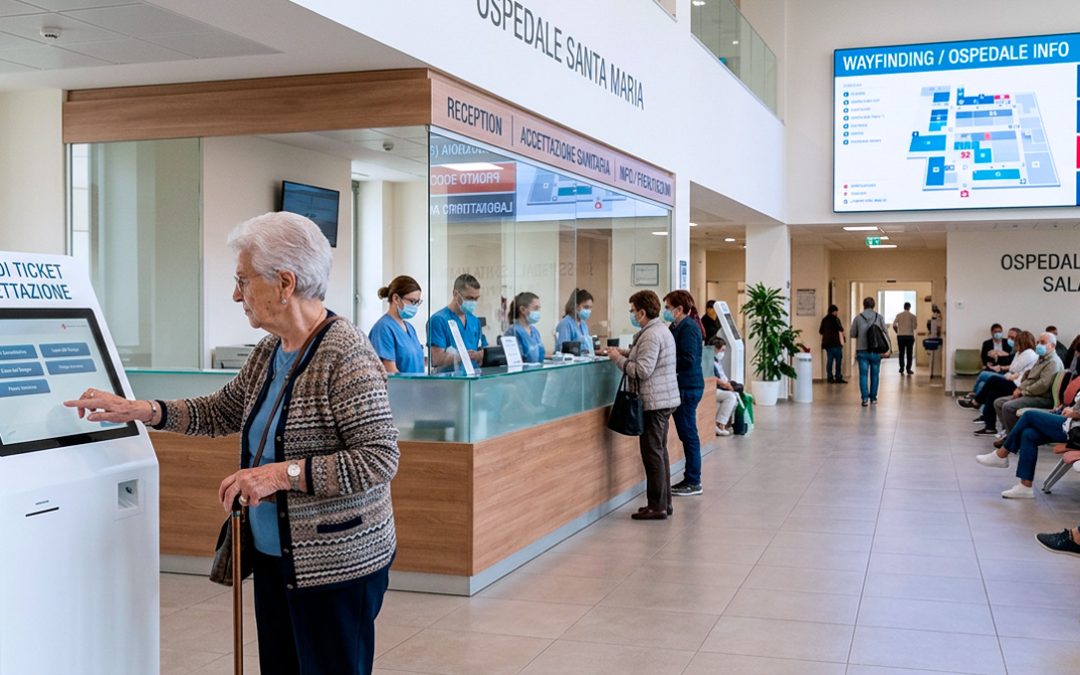

Every day, in pharmacies, clinics, bank branches, public offices, and retail outlets, thousands of people wait their turn.
What seems like a trivial process is actually one of the most delicate moments in the entire customer experience: the moment when a first impression of the service is formed, tolerance or frustration develops, and the decision is made whether to return or not.
Queue management is the discipline—and now also the technology—that transforms this critical moment into an orderly, predictable, and often even positive experience.
This guide explains what it is, how it works, what tools exist, and how to choose the best solution for your organization.
Table of Contents
- What is queue management and why is it strategic
- The real cost of a disorganized queue
- The psychology of waiting: how people experience time in line
- Physical queue vs. virtual queue: differences and advantages
- The components of a modern queue management system
- Software, online booking, and flow analysis
- Artificial intelligence and predictive analytics
- Queue management for Industry
- How to choose the right system for your organization
- Kiosk solutions for queue management
- FAQ
1. What is queue management and why is it strategic?
Queue management is the set of processes, tools, and technologies that organize access to services, reduce perceived wait times, and improve the user experience—for both the customer and the agent.
It’s not just about “tidying up the queue.” Effective queue management is a strategic tool that impacts three dimensions simultaneously:
Customer experience.
An orderly, transparent, and predictable wait is perceived as significantly shorter and less stressful than a chaotic one, even when the objective duration is identical.
The quality of the wait influences the overall service rating more than almost any other variable.
Operational efficiency.
A system that directs every request to the right operator reduces downtime, balances workload across counters, and reduces unplanned interruptions—with a direct impact on staff productivity.
Data and intelligence.
Modern systems collect data on flows, wait times, and peaks. This data allows us to optimize staff planning, anticipate critical moments, and continuously improve service organization.
The ability to effectively manage queues is now a concrete competitive advantage: it differentiates organizations that master it from those that still treat it as an unsolvable problem.
2. The real cost of a disorganized line
Before evaluating a solution, it’s worth quantifying the problem.
Disorganized waiting has concrete and often underestimated costs:
Service abandonment.
Sector studies in large-scale retail stores estimate that between 8% and 15% of customers abandon the line at serviced counters during peak traffic periods, without completing their purchase. Each abandonment represents lost revenue and a potentially lost customer.
Loss of worker productivity.
Researcher Gloria Mark (UC Irvine) has documented that after an unplanned interruption, a worker takes an average of 23 minutes to return to their previous level of concentration. In a high-traffic environment—pharmacy, administrative desk, hospital reception—interruptions multiply during peaks, significantly impacting service quality.
Negative brand perception.
Waiting is often the first direct contact between the customer and the organization. A chaotic entrance is more memorable than any subsequent positive interaction.
According to PwC (Experience is Everything, 2018), 73% of consumers say the overall experience is a determining factor in their purchasing decisions, equal to price and product quality.
3. The psychology of waiting: how people experience time in line
There is extensive research on how people perceive waiting time—and the findings are surprising to those unfamiliar with them.
David Maister, professor at Harvard Business School, identified in his essay The Psychology of Waiting Lines (1985) a series of principles that are still considered the benchmark in the customer experience sector:
- An uninformed wait feels longer than one with visible updates on the remaining time.
- An anxious wait—where you don’t know who’s coming first or when you’ll be called—is perceived as longer than it is.
- A wait with a clear purpose is tolerated better than an indefinite one.
- A wait in which there is a perception of fairness—no one outnumbers anyone without visible reason—reduces frustration even when the waiting time is the same.
An MIT study (Larson, 1987) confirmed that single-stop queues are perceived as fairer and generate less frustration than parallel queues, even when average waiting times are identical.
The practical conclusion is crucial: a queue management system does not necessarily reduce objective waiting time, but radically transforms how that wait is experienced.
This means that investing in a good system has a return even regardless of its ability to reduce actual waiting times.
→ For a more in-depth look at the psychology of waiting and its design implications, read: Real waiting, perceived waiting: why the difference changes everything.
4. Physical queue vs. virtual queue: differences and advantages
Queue management systems are divided into two broad categories:
Physical queue — The customer is physically present in the waiting area.
They receive a number, wait in the waiting room, and are called to the counter. This is the classic queue-eliminating model, still the most widespread in Italy in pharmacies, public offices, and bank branches.
Virtual queue — The customer registers in line without necessarily being present.
They can receive updates via SMS or app and return as their turn approaches. This reduces the perception of waiting and increases satisfaction, but requires greater technological infrastructure.
Online booking and appointment management — The most recent development: the customer books the service in advance via the web or smartphone, choosing the day, time, and type of service. Upon arrival, the customer is automatically called at the scheduled time.
This model almost completely eliminates spontaneous waiting for booked users, while maintaining the management of unscheduled access.
The three models are not mutually exclusive—the optimal solution for many organizations is a combination of all three: online reservations for those who plan ahead, a virtual queue for those who arrive without an appointment, and a physical queue as a fallback for those who don’t use digital tools.
5. The Components of a Modern Queue Management System
A modern queue management system is not a single device but an ecosystem of components that communicate with each other:
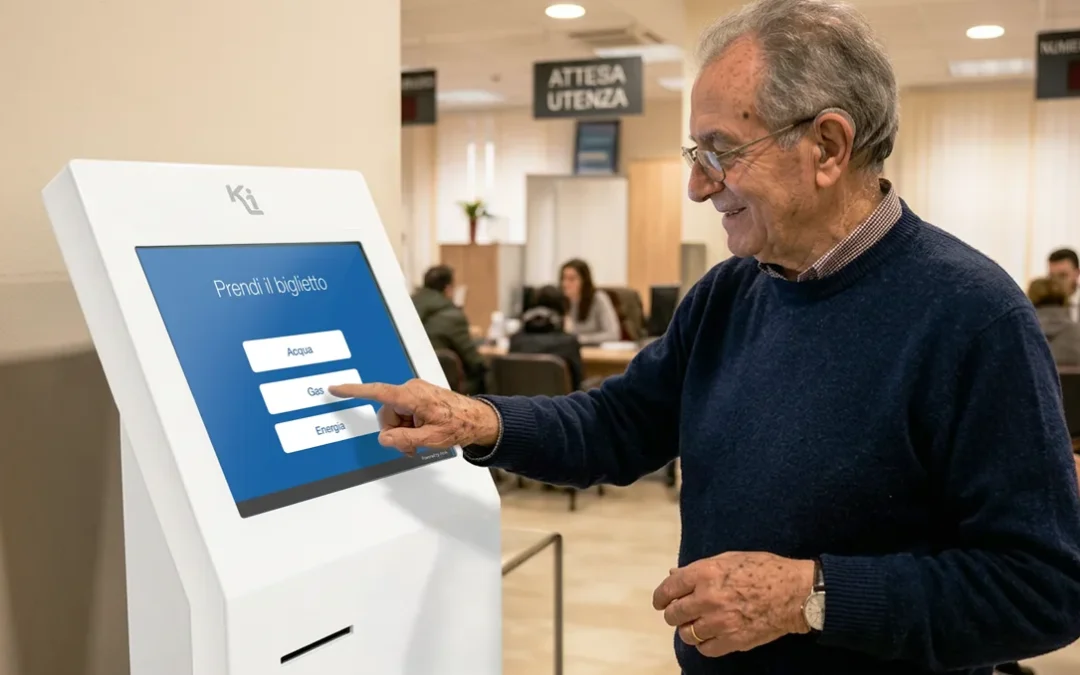
- Totem or service selection point — The interface through which the customer registers, selects the type of service, and receives the ticket. It can be a touchscreen kiosk, a tablet, a mobile app, or a combination of these.
It is the entry point to the system and must be intuitive, accessible, and strategically positioned. - Ticketing system — Physical (ticket printing) or digital (smartphone notification).The trend is toward digital tickets, which eliminate paper costs and allow for proactive notifications.
- Call display — Monitors positioned in the waiting room that display the numbers called and the relevant counter in real time. They reduce wait times and the number of questions posed to staff.
- Terminal Displays — Small screens near the service counters that identify the counter and the number currently being served.
- Operator Console — The interface with which operators call the next number, manage priorities, transfer customers between counters, and monitor the situation in real time.
- Central Management Software — The heart of the system: it coordinates all components, manages routing rules, collects data, and generates reports.
→ For more information on totems as a design element for waiting areas, read: Queue management totems: when waiting becomes an integral part of the project.
6. Software, online booking, and flow analysis
The software is the component that transforms a simple number dispenser into an intelligent flow management system.
Basic functions: Number rotation management, service type addressing, voice and visual calling, basic wait time statistics.
Advanced features: intelligent routing to the most competent operator for the requested service, priority management (urgents, booked appointments, special categories), integration with CRM systems, multi-location management from a single platform, real-time dashboard for managers.
Online booking: integration with a booking system that allows customers to book the service before arriving. Upon arrival, the customer identifies himself at the kiosk and is automatically placed in the queue with the correct priority compared to spontaneous access.
Flow analysis: data collection on volumes by time and day, average waiting times per service, performance per operator, and peak traffic. This data—according to Qmatic and Q-nomy—allows organizations that use it to optimize staff planning to reduce waiting times by between 20% and 40%.
→ To learn more about how the online booking system integrates with queue management, explore Kiosk Buk, the Kiosk solution for booking and managing appointments.
7. Artificial Intelligence and predictive analytics
The most advanced technologies are introducing AI into queue management, with concrete applications already in place:
- Prediction of peak traffic. Machine learning algorithms analyze historical data to predict expected volumes in each time slot, allowing staffing to be planned proactively rather than reactively.
- Intelligent routing. Systems that analyze the request profile and the skills of available operators to optimize assignment in real time—not just “first available” but “best-suited operator.”
- Dynamic wait time estimation. Instead of a static estimate, the system updates the wait time forecast in real time for each customer in line, taking into account the estimated complexity of previous requests.
- Audience analytics in waiting areas. Sensors integrated into displays can detect the flow of people, estimate waiting times of permanence and provide aggregated data on space usage—useful for optimizing layout and communication.
8. Queue Management by Sector
Each sector has specific needs. Here are the main application contexts with links to available in-depth articles:
Pharmacies — Management of multiple services (consultations, collections, vaccinations, healthcare services) with routing to the most appropriate counter and integration with booking systems.
→ Queue management for pharmacies: how it works, how much it costs, and why it increases sales
Large-scale retail trade — Management of staffed counters during peak traffic, reduction of queue abandonment, integration with the store layout.
→ More time shopping, less time waiting in line: the role of queue management systems in new supermarkets
Doctor’s offices and healthcare facilities — Managing waiting time as part of the patient journey, reducing patient stress, integrating with booking and triage.
→ Queue management in medical practices
Veterinary clinics — Organizing flows in contexts where animal stress is a critical variable.
→ Queue management in veterinary clinics: a major advantage for customers and staff
Embassies and consulates — Managing heterogeneous administrative procedures with users often under stress or in urgent situations.
→ Queue management systems for embassies and consulates
Multi-site organizations — Centralized management of multiple locations or branches from a single platform, with aggregated statistics and remote configuration.
→ Multi-site queue management system: efficiency, customer satisfaction, and advanced analytics
Retail and trade marketing — Use queue management displays as communication and promotional tools while customers wait.
→ Trade marketing: digital kiosks and queue management systems to maximize sales
9. How to choose the right system for your organization
The choice of queue management system depends on a few key variables:
- Number and type of services provided.
A system with a single type of service requires a much simpler solution than one with 5–10 distinct services, operators with different skills, and different priorities. - Flow volume and peaks.
An organization with regular and predictable traffic has different needs than one with peaks concentrated in specific time slots. Systems with predictive analytics are more useful in the latter case. - Presence of booked appointments.If you manage both spontaneous walk-ins and booked appointments, the system must be able to integrate them without creating perceived disparities in waiting times.
- Number of locations.A single location can be managed with a standalone system; multi-location networks require centralized platforms with remote management.
- Space and architectural design.Totems and displays are physical elements that fit into the space. The choice must take into account the layout, visitor flow, and the organization’s visual identity.
- Integration with existing systems.CRM, management software, booking system: check compatibility before purchasing to avoid costly later customizations.
→ We have dedicated a specific guide to this topic: How to choose a queue management system (without wasting money)
10. Kiosk solutions for queue management
Kiosk develops queue management solutions for organizations of all sizes and sectors.
The two main platforms:
- Kiosk Hydra — The advanced queue management system for organizations with complex flows: service selection via totem or tablet, intelligent addressing, priority management, advanced statistics, predictive analysis, multi-location management, video counter and integration with digital signage display.
→ Discover Kiosk Hydra - Kiosk Buk — The online booking and appointment management system, designed to integrate with on-site queue management systems. It simultaneously manages booked users and spontaneous accesses, with automatic notifications and monitoring dashboards.
→ Discover Kiosk Buk
For a complete in-depth analysis of what a queue management system is, how it works and when to adopt it, read our Complete guide to the queue management system.

Do you want to understand which queue management system is best suited to your organization?
Tell us about your project
11. FAQ
What is the difference between queue management and queue elimination?
Queue management is a specific tool—the system that distributes numbers and calls customers at the counter. Queue management is the broader concept that includes queue elimination, but also online booking, virtual queuing, flow analysis, and waiting space design.
Does a queue management system really reduce wait times?
Not necessarily the actual wait times—but it radically transforms how that wait is perceived. Industry data shows reductions in perceived wait times of between 20% and 40% after implementing systems with flow analysis, thanks to optimized staff scheduling.
How much does a queue management system cost?
The cost varies significantly depending on its complexity: from entry-level solutions for simple environments to enterprise platforms for multi-site organizations with thousands of transactions per day. The most effective way to get an accurate estimate is an analysis of your specific organizational needs.
Is it possible to integrate online booking with a physical queue management system?
es. Modern systems like Kiosk Buk are designed for exactly this: to simultaneously manage users with booked appointments and spontaneous access, with configurable priority rules.
What happens if a customer with an appointment arrives late?
Advanced systems handle this scenario with configurable rules: a grace period, re-entry into the queue with a changed priority, and automatic notification to the operator. The configuration depends on your organization’s policies.
Can queue management displays also be used for communication?
Yes, it’s one of the most overlooked aspects. Displays placed in the waiting room are in front of people with their available attention—an opportunity to convey informational, promotional, or service messages. Eye-tracking studies in retail settings show recall rates up to 70% higher than standard static signage.
How long does implementation take?
For simple systems (single location, few services), installation is on the order of days. For multi-site enterprise platforms with complex integrations, the project can take weeks.
The critical phase is not the technical installation but the configuration of services, priorities, and staff training.