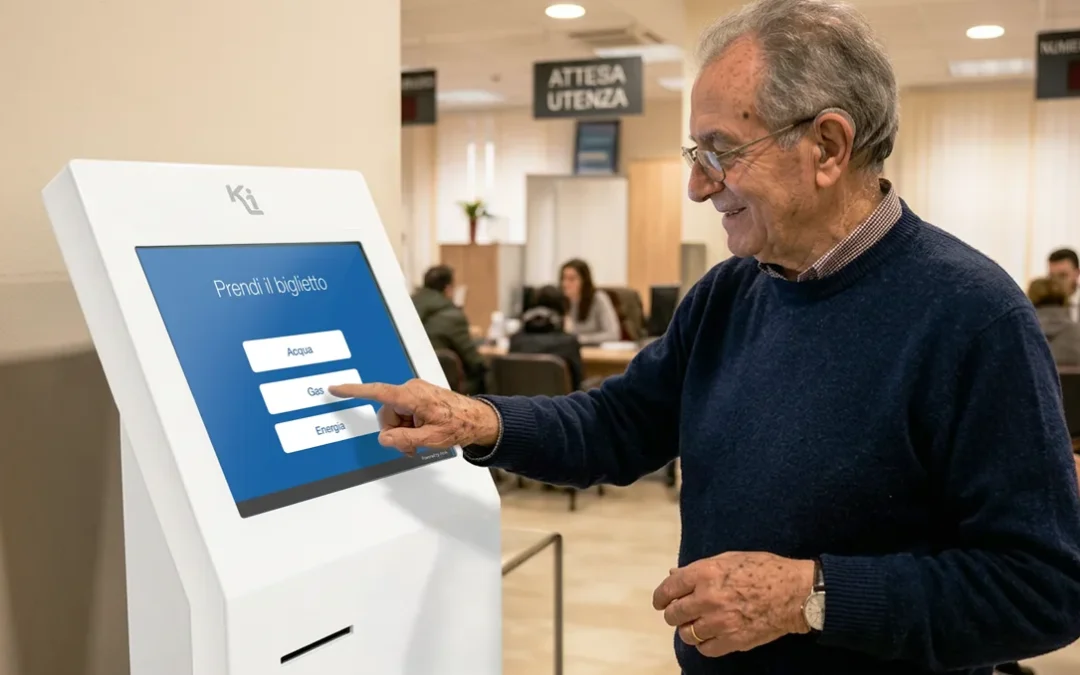
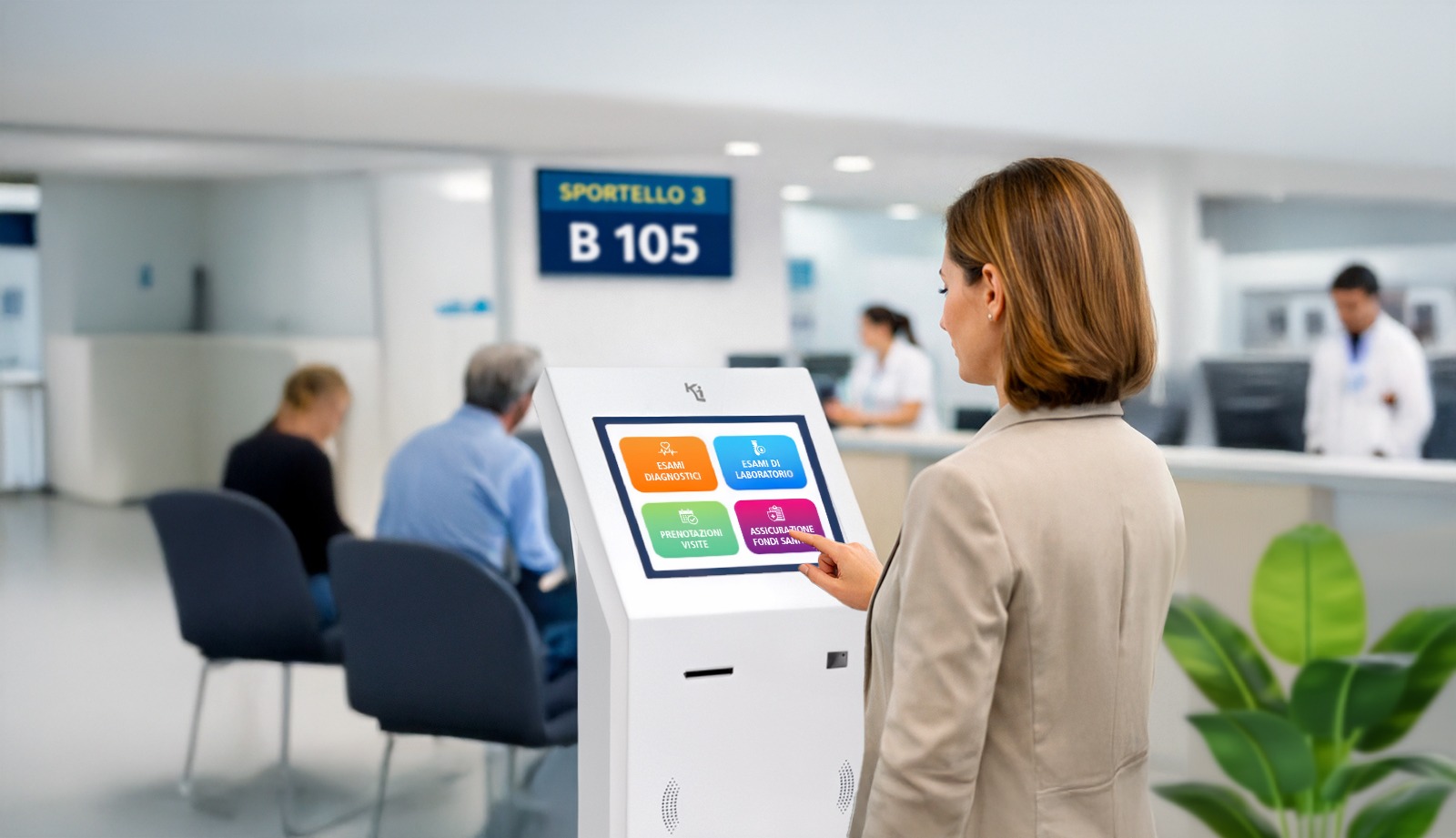
In many contexts—pharmacies, supermarkets, clinics, public offices, or administrative counters—queue management is one of the factors that most influences the perception of service.
When multiple people arrive simultaneously to access different services, the queue quickly becomes a critical point. Not only because it generates waiting times, but also because it often creates confusion: users unsure where to stand, operators constantly interrupted, requests routed to the wrong counter.
For this reason, many organizations have adopted queue management systems. But compared to the early models, which simply distributed sequential numbers, current systems have become advanced platforms for managing user flow.
Today, queue management systems serve more than just keeping lines organized: they help organize access to services, correctly direct people, and improve the overall customer experience.
This guide focuses on queue management systems as a specific tool. If you want the complete picture of queue management—methodologies, technologies, and solution comparisons—read our complete guide to queue management.
Table of Contents
- The invisible problem: the real cost of disorganized waiting
- The psychology of waiting: why order changes everything
- What is a queue management system
- Why organizations adopt a queue management system
- Traditional queue management and advanced queue management
- Advanced queue management systems
- Queue management and service organization
- The Evolution: Online Booking and Appointment Management
- Where Queue Management Systems Are Used
- Beyond the Queue: Intelligent Flow Management
1 – The unseen problem: the real cost of disorganized waiting
Before understanding how a queue management system works, it’s worth understanding what happens when there isn’t one—or when the existing one is inadequate.
Disorganized waiting has a concrete cost for organizations, which is often underestimated:
- Customers who abandon: Studies on consumer behavior show that a significant percentage of people abandon the line after a few minutes if they don’t perceive order or predictability in the wait.
- Less productive agents: Every unplanned interruption—a customer approaching the wrong counter, an out-of-context question, a misdirected request—fragments the agents’ work and reduces the quality of service.
- Negative brand perception: The waiting experience is often the first direct contact between the customer and the organization. A chaotic entrance leaves a greater impression than any subsequent positive interaction.
DATA
73% of consumers say that the overall experience is a determining factor in their purchasing decisions, equal to price and product quality. In large-scale retail, industry research estimates that between 8% and 15% of customers abandon the queue at serviced counters during peak traffic periods without completing their purchase.
Source: PwC, Experience is Everything (2018); industry estimates on European large-scale retail
It’s not just a question of how long you wait, but how you wait. Even the objective length of the wait is perceived radically differently depending on the context—organized or chaotic.
2 – The Psychology of Waiting: Why Order Changes Everything
There is consolidated research on the psychology of waiting. David Maister, a professor at Harvard Business School, identified in his essay “The Psychology of Waiting Lines” (1985) a series of principles that describe how people experience time in line—still considered a benchmark in the customer experience field.
Her main findings:
- An uninformed wait feels longer than one with visible updates on the remaining time.
- An anxious wait—where you don’t know who’s coming first, or when you’ll be called—is perceived as longer than it actually is.
- A wait with a clear purpose is tolerated better than an indefinite wait.
- A wait where there’s a sense of fairness—no one beats anyone without apparent reason—reduces frustration even when the time is the same.
FURTHER INFORMATION
An MIT study (Larson, 1987) confirmed that single-stop queues are perceived as fairer and generate less frustration than parallel queues, even when the average waiting times are identical. The principle applies directly to queue management: a system that assigns a visible number and displays the queue’s progression reduces waiting anxiety, regardless of the actual length.Source: Maister, D. (1985). The Psychology of Waiting Lines; Larson, R. (1987). Perspectives on Queues. Operations Research.
A queue management system does not necessarily reduce objective wait time. But it radically transforms how that wait is experienced.
→ We explored this topic in a dedicated article: “Real wait, perceived wait: why the difference changes everything”
3 – What is a queue management system?
A queue management system is a technological solution that allows you to organize the order of access to services, avoiding physical lines.
The principle is simple: the user selects the service they need, receives a ticket, and waits at the counter or counter.
In practice, however, a modern system is composed of several elements that work together:
- a totem or service selection point
- a ticket issuing system
- display for calling numbers
- an operator console
- a central management software
This system allows you to transform a disorganized queue into an organized flow, where each request is directed to the most appropriate service.
→ If you want to learn more about how the queue management totem fits into the design of the waiting area, read: “Queue Management Totem: when waiting becomes an integral part of the project”.
4 – Why organizations adopt a queue management system
The main reason is simple: to better manage people flows.
When requests increase, manual queue management quickly becomes inefficient. Some operators become overloaded while others remain idle, and users often don’t know which counter is the right one.
A queue management system, on the other hand, allows you to:
- direct the customer to the correct service
- distribute work among agents
- reduce confusion in waiting areas
- improve the organization’s perception
But there’s a benefit that’s often overlooked: the impact on agent productivity.
DATA – THE COST OF INTERRUPTIONS
Researcher Gloria Mark (UC Irvine) has documented that, after an unplanned interruption, a worker takes an average of 23 minutes to return to their previous level of concentration.
In a high-traffic environment like a pharmacy or administrative counter, where interruptions multiply during peaks, the impact on service quality and operator satisfaction is significant.Source: Gloria Mark, UC Irvine — Research on Cognitive Interruption at Work (2005-2008)
A queue management system eliminates most of these interruptions. The result isn’t just a more orderly queue: it’s an operations team that works more efficiently and with less stress.
→ For detailed price ranges and a comparison between purchasing and leasing, read: How much does a queue management system cost: the complete guide to 2026 prices
5 – Traditional queue management and advanced queue management
Many people still associate queue management with traditional sequential dialing.
In reality, more advanced systems work very differently.
A modern queue management system allows you to manage:
- different services
- operators with different skills
- call priority
- flow statistics
- integration with communication displays
This means that the system doesn’t just call the next number, but can direct each request to the most appropriate operator, improving both wait times and service efficiency.
6 – Advanced queue management systems
The most modern queue management systems do more than simply distribute sequential numbers.
They integrate advanced functions for service management, intelligent user routing, and flow analysis.
Solutions developed by Kiosk, such as Kiosk Hydra, allow for structured access to services through:
- Service selection via kiosk or tablet
- Direction to the most competent counter
- Management of different services
- Statistics on waiting times and flows
- Predictive analysis
- Multi-location management
- Video counter and customer satisfaction monitoring
- Digital signage display management
In this way, the queue management system becomes a tool for operational organization and improved customer experience.
→ If you’d like to learn more about this solution, visit the complete datasheet for Kiosk Hydra, the enterprise queue management software.
7 – Queue management and service organization
One of the most interesting aspects of modern queue management systems is the ability to structure services more clearly.
Users no longer simply “stand in line”: they choose the type of service they need.
This allows for more effective organization of operator activities. For example, consulting, product collection, payments, and technical assistance can be managed as separate services, each with different timeframes and skills.
This approach reduces downtime and improves operational efficiency.
→ Further information: How to choose a Queue Management System (without wasting money)
8 – The evolution: online booking and appointment management
In recent years, queue management has further evolved thanks to the ability to book services online.
In this model, users do not have to go to the facility to queue: they can book directly from the website or smartphone, choosing the day, time, and service requested.
When they arrive at the facility, they are automatically called at the scheduled time.
In Kiosk solutions, this functionality is managed by the Kiosk Buk software, designed to integrate online booking with on-site queue management systems.
The combination of booking and queue management allows for the simultaneous management of:
- booked users
- spontaneous access
- services with different time slots
The result is much more efficient flow management.
DATO — THE POST-PANDEMIC ACCELERATION
According to McKinsey, the 2020-2022 period compressed into just a few months a digital transition that would normally have taken five years. In healthcare and retail, online booking has gone from an optional feature to a standard customer expectation. Organizations that don’t offer this option are now perceived as structurally lagging behind in terms of service expectations.
Source: McKinsey Global Survey on Digital Transformation (2020)
→ Learn more about the Buk Kiosk booking system
9 – Where are queue management systems used?
Queue management systems are now widespread in numerous sectors.
Pharmacies
In modern pharmacies, the services offered are increasingly numerous: consultations, healthcare services, product collections, vaccinations. A queue management system allows you to organize these requests and direct each customer to the most appropriate counter.
→ Learn more: “Queue management for pharmacies: how it works, how much it costs, and why it increases sales”
Doctor’s offices and healthcare facilities
In clinics, queue management is crucial for the perceived quality of service and patient peace of mind.
→ Further information: Queue management in medical clinics
Supermarkets and large-scale retail trade
In supermarkets, queue management systems are used primarily at staffed counters, where high traffic levels need to be managed.
→ Further information: “More time shopping, less time waiting in line: the role of queue management systems in new supermarkets”
Veterinary Clinics
Even in veterinary facilities, organizing patient flows is important to reduce animal stress and improve the reception experience.
→ Learn more: “Queue Eliminators in Veterinary Clinics: a huge advantage for clients and staff”
Embassies and Consulates
Queue management systems at consular offices allow for the management of a wide variety of administrative procedures.
→ Learn more: “Queue Management Systems for Embassies and Consulates “
Multi-Site Organizations
When a facility has multiple locations or offices, the queue management system can be centralized and managed from a single platform.
→ Further information: “Multi-site queue management system: efficiency, customer satisfaction, and advanced analytics for companies and organizations.”
Queue management and point-of-sale marketing
An often overlooked aspect is the role of queue management in point-of-sale communication.
Displays used for dialing numbers can become communication, information, or promotional tools.
→ Further information: “Trade Marketing: digital totems and queue management systems to maximize sales”
A waiting customer is a customer with an open gaze and willing attention. Queue management displays are in a prime position: in front of people who are waiting, who have lowered their defenses typical of traditional advertising. The value of that space—informational or promotional—is often underestimated.
DATA — CAPTIVE ATTENTION
Research on in-store behavior distinguishes between shoppers on the move and shoppers standing still. The latter have a significantly higher attention span for surrounding visual content.
Eye-tracking studies conducted in the retail sector show that displays positioned in the field of vision of those waiting have recall rates up to 70% higher than standard static signage.A stationary customer—with an unimpeded gaze and open attention—is a prime target for any informational or promotional message.
Source: POPAI / Path to Purchase Institute — studies on digital signage and purchasing behavior; eye-tracking research in retail contexts
This makes waiting time a useful opportunity to convey messages, promote services, or improve the customer experience.
10 – Beyond the queue: intelligent flow management
The true evolution of queue management systems is the transition from simple queue management to intelligent user flow management.
Through statistics and data analysis, it is possible to understand:
- which services are most in demand
- when peak traffic occurs
- how long the average wait is
This information allows organizations to improve staff planning and optimize service organization.
DATA — THE VALUE OF OPERATIONAL DATA
In the banking and public services sectors, where queue management systems have been consolidated for decades, Qmatic and Q-nomy have documented reductions in waiting times of between 20% and 40% after implementing systems with flow analysis. The mechanism is simple: historical data allows them to anticipate peaks, redeploy staff proactively, and reduce downtime.
The same principle applies in pharmacies, large-scale retail trade, and public services.
Source: Qmatic, State of Customer Journeys Report; Q-nomy case studies (2018-2023)

Want to understand which queue management system is best for your business?
If you’d like to analyze your specific case and understand which architecture would work best, we can evaluate it together. Contact us now.
Tell us about your project