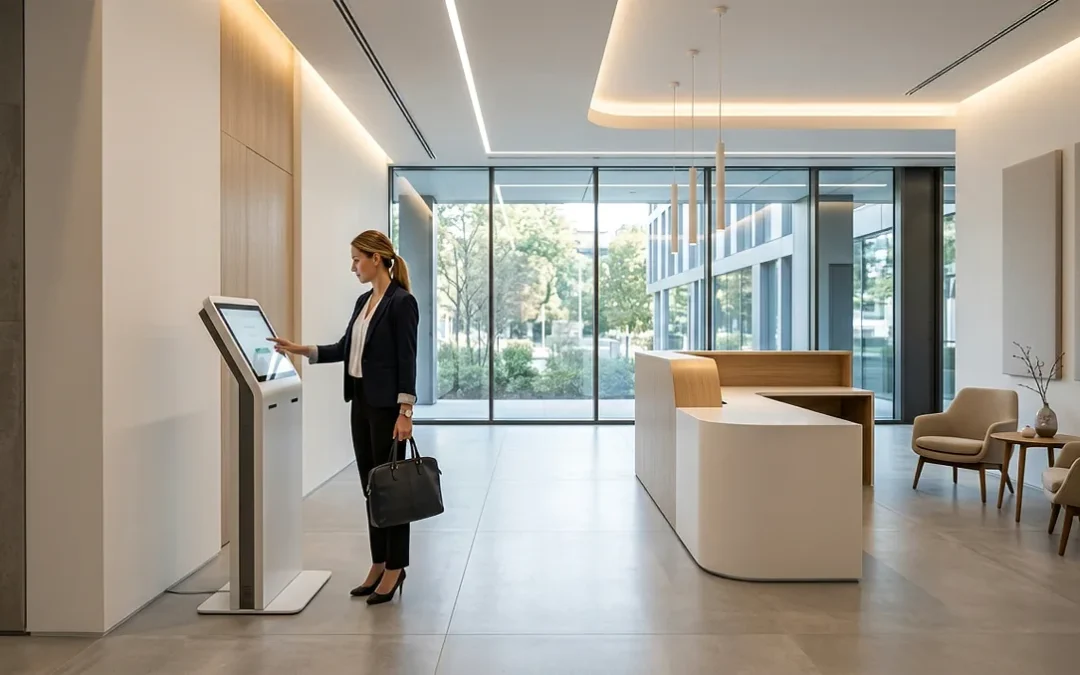

A visitor’s arrival at a company is much more than a simple operational moment.
It’s the first point of contact with the organization, its way of working, its culture. Yet, in many Italian and European companies, this process is still managed with inadequate tools: a paper register, a signature, a handwritten badge.
Things are changing rapidly. According to the report Global Visitor Management System Market (MarketsandMarkets, 2023), the visitor management system market is growing at a compound annual growth rate (CAGR) of over 13.7%, driven by the growing focus on physical security, regulatory compliance, and the quality of the guest experience.
Companies are no longer simply managing “entrances”: they are managing flows, data, security, and brand perception.
This guide explores every aspect of digital visitor registration: from the limitations of traditional systems to available technologies, from GDPR compliance to the impact on corporate image. It is designed for those who need to make an informed decision.
Table of Contents
- Why visitor registration is a strategic process
- The limitations of paper-based registers
- What is a digital visitor management system
- How digital visitor registration works
- Advantages of digital visitor registration
- Differences between paper-based and digital registers
- Operational efficiency and access control
- Visitor registration and GDPR
- Available technologies: tablets, totems, QR codes
- When it’s time to go digital
- Hospitality and corporate image
- Visitor management and security: the role in emergency plans
- How to choose the right solution
- Integration with company systems
- FAQ
1. Why visitor registration is a strategic process
When we talk about visitor registration, we tend to think of a simple administrative requirement. In reality, it’s a process that involves at least four distinct organizational dimensions.
Physical security. Knowing who is present within the company at any given time is a prerequisite for any emergency management plan. In the event of an evacuation, fire, or accident, the list of those present must be available in real time, not reconstructed after the fact by leafing through a paper register.
Regulatory compliance. The GDPR (EU Regulation 2016/679) also applies to data collected upon entry: name, surname, company of origin, time of entry, and any identity document. The management of this data must comply with specific data minimization, retention, and deletion requirements.
Organizing Flows. Many companies experience dozens of people with different roles and needs every day: customers, suppliers, consultants, maintenance technicians, interview candidates, business partners, auditors. Properly managing these accesses means ensuring order, traceability, and the ability to analyze data over time.
Visitor Experience. The way a person is greeted at the entrance helps build the perception of the company. A fluid, professional, and digitalized process communicates care, organization, and modernity. A manual counter with waiting times and paper forms communicates the opposite.
2. The Limitations of the Paper Register
The paper register has been the most popular tool for access management for decades. It requires no technological infrastructure, is easy to use, and seemingly risk-free. But it has structural limitations that become increasingly significant as the organization grows.
Absent or unreliable traceability. Information is often incomplete, illegible, difficult to access, and impossible to aggregate or analyze. There’s no easy way to answer questions like: “How many external visitors did we have this month? Which supplier came in most often? What time of day is the peak attendance?”
No real-time visibility.
With a paper log, it’s impossible to know who is physically present in the building at any given time. In an emergency, this is a serious problem.
Privacy risks.
Every person who signs the log can read the data of their predecessor: name, company, arrival time, and often even the name of their internal contact. This exposes the company to potential GDPR violations and embarrassing situations (think of two competitors finding themselves reading each other’s data on the same sheet of paper).
Impossible to integrate.
The paper register doesn’t communicate with any other system: not with the staff calendar, not with physical access control systems, not with HR platforms. It’s an island of unstructured data.
Corporate image.
In a context where companies are investing in modern offices, digital systems, and a curated brand identity, welcoming visitors with a notebook is a perceptual dissonance that many guests notice.
→ For a more in-depth comparison between paper and digital approaches, read: Visitor registration in the company: the complete comparison
3 – What is a digital visitor management system?
A visitor management system (VM) is a software platform—often accompanied by dedicated hardware—that digitizes the entire registration and external access management process.
Visitors can register through various channels:
- Tablet or kiosk at reception, filling out a digital form upon arrival
- QR code, scannable with your smartphone for contactless check-in
- Online pre-registration, sent by the company before the visit, so that check-in is already completed upon arrival
The system automatically records the information, archives it in a structured manner, and makes it available in real time to authorized operators. It can send automatic notifications to the internal contact when the visitor arrives, print personalized badges, collect digital signatures for NDAs or privacy notices, and generate access reports.
A well-configured VM system transforms the reception from an operational bottleneck to a smooth and efficient reception point.
4. How digital visitor registration works
A typical visitor management system follows these steps:
Visitor access
- Scan a QR code at the entry point.
- Launching a digital module on totem or tablet.
- Completing an online reservation.
Completing the form
The visitor enters mandatory data (name, surname, reason for the visit, contact person in the company) and optional data (company of origin, telephone number, address, etc.).
At the end, a digital or printed temporary badge may appear, or an access code for the gates.
Real-time traceability
The system records the date and time of entry and exit, matching the visitor to the contact person and the area visited.
In the event of an emergency, a list of those present on site is quickly generated.
As in the case of Kiosk Varco, the system automatically records entry, exit and internal contact person for each visitor, matching everything to the relevant workstation or location.
Integration with other systems
Many software connect with:
- Access control systems and company badges
- Physical security solutions,
- Appointment management platforms (e.g. calendars, internal CRMs).
5. Advantages of digital visitor registration
Moving from the paper register to a digital system like Kiosk Varco brings concrete advantages in several areas:
1. Efficiency and error reduction
- Elimination of duplicates, illegible writing and missing data.
- Automation of check‑in, badges and invitations, with less manual work for reception and security.
- Fast and linear queue, especially during peaks of attendance (fairs, events, open days).
2. Physical security and traceability
- Real-time visibility of who is present in the company, useful in case of emergencies or accidents.
- More precise control of access to sensitive areas (offices, warehouses, laboratories).
- Integration with access control systems and automatic alerts in case of delays or anomalous flows.
3. Compliance and GDPR
- Transparency on the data collected, with consent and privacy information integrated into the form.
- Data storage in secure digital format, with configurable retention times.
- Possibility to generate certifiable reports for audits and inspections.
4. Professional corporate image
- A modern reception with digital totem, badge and clear procedures communicates innovation and attention to the customer.
- Elimination of cumbersome and often confusing paper records, replaced by a fluid and contactless experience.
5. Decision analysis and reporting
- Analysis of visitor flows (number of entries, time slots, busiest areas).
- Monitoring of visits by interlocutor or department, useful for HR, sales and facility.
- Statistics to choose where to invest in bus services, staff or new infrastructure.
6. Differences between paper register and digital registration
The old paper registers still have some supporters, but digitization offers a clear step forward:
7. Operational Efficiency and Access Control
One of the most immediate benefits of digital registration is the efficiency gains for reception staff and the entire organization.
Real-time visibility.
The system shows at all times who is present at the company, who is expected in the next few hours, and who has already checked out. This eliminates uncertainty and reduces interruptions for internal staff.
Automatic notifications.
When a visitor completes registration, the internal contact receives a notification via email, SMS, or app. There’s no need for reception to call or look for the person: the process starts automatically.
Reduced wait times.
Pre-registration allows frequent visitors—such as maintenance technicians or couriers—to complete check-in in seconds, without having to refill the same information each time.
Reporting and analysis.
Data collected over time provides a clear view of access flows: peak times, visitor types, frequency per vendor, average visit duration. This information supports operational decisions such as staffing levels at reception or managing waiting spaces.
→ Further information: How digital access registration improves efficiency and security
8. Visitor Registration and GDPR
The collection of personal data upon entry falls squarely within the scope of the GDPR. This means that the company, as data controller, must comply with a series of specific obligations.
Legal Basis.
The processing of visitor data must be based on a legitimate basis: in most cases, this is the company’s legitimate interest (security of premises) or compliance with legal obligations. This choice must be documented.
Information Notice.
The visitor must be informed of the processing before or at the time of data collection. A digital system allows the information notice to be integrated directly into the registration flow, with explicit acceptance tracked and documented.
Data Minimization.
Only the strictly necessary data should be collected. A VM system allows you to precisely configure which fields to fill in, avoiding the excessive data collection typical of generic paper forms.
Retention and Deletion.
Visitor data cannot be retained indefinitely. A digital system allows for the setting of automatic retention and deletion policies, in accordance with the data processing records.
Access and visibility.
Unlike paper registers, a digital system displays data only to authorized personnel, eliminating the risk of inadvertent exposure.
→ Further information: Visitor registration and GDPR: the rules you can’t ignore
9. Available technologies: tablets, totems, QR codes
Visitor management systems can leverage various technologies, often in combination. The choice depends on the context, the volume of visitors, and the desired level of automation.
→ Further information: Totems, tablets, and QR codes: which technologies to choose for visitor registration
→ Further information: “Contactless check-in: how touchless is revolutionizing corporate hospitality“.
→ Find out how Kiosk Varco digitizes your reception.
10. When it’s time to digitize
Many companies put off digitizing their reception because the current system “works.” But there are clear signs that it’s time to change approach.
Increase in visitor numbers.
When traffic increases, the paper system becomes a bottleneck. Wait times get longer, errors increase, and reception staff are overwhelmed.
Difficulties managing the reception.
If staff spend a significant portion of their time manually managing registrations, notifying internal contacts, or searching for information on past visitors, it’s a sign that the process isn’t efficient.
Audits, certifications, or inspections.
Companies operating in regulated sectors (pharmaceuticals, food, finance, healthcare) or that must maintain certifications such as ISO 9001 or ISO 27001 often have specific access tracking requirements. A digital system greatly simplifies managing these requirements.
Regulatory changes.
Updating internal privacy policies or new DPO instructions may require a system that ensures verifiable compliance.
New location or renovation of premises.
Opening a new location or redesigning the reception area is the ideal time to integrate a VM system from the start.
→ Further reading: “5 signs that your company needs a digital registration system”
→ Further reading: “Digital visitor register: how it’s changing security and hospitality in the company”.
11. Welcome and Corporate Image
Visitor registration isn’t just a technical procedure. It’s a moment of communication, perhaps the most immediate one a company has with its external stakeholders.
A visitor arriving at reception brings with them expectations—often unconscious—about the quality of the organization they’re about to encounter.
A modern, seamless, and personalized check-in process confirms those expectations. A manual, slow, or disorganized process contradicts them, regardless of how excellent the product or service the company offers.
The most advanced visitor management systems allow you to personalize the experience in various ways:
- Personalized welcome messages, with the visitor’s name and that of their internal contact person
- Visual branding, with company logo, colors, and images during the registration process
- Informative content, such as corporate videos, space maps, or practical information (parking, Wi-Fi, code of conduct)
- Customized forms by type of visit (suppliers, customers, candidates, audits)
→ Further information: “The art of welcoming: ideas for personalizing visitor registration”
→ Further information: “Corporate reception and visitor registration”
12. Visitor management and security: their role in emergency plans
Security is probably the most compelling reason to adopt a digital visitor management system. And it’s not just about cybersecurity or data protection: it’s about people’s physical safety.
In the event of an emergency—fire, evacuation, accident—it’s essential to know immediately how many people are in the building and where they are.
With a paper register, this information is difficult to obtain quickly and often unreliable (who remembers to update the register upon leaving?).
A digital VM system allows you to:
- Generate a real-time presence list, accessible by security personnel or emergency responders, even from a mobile device
- Conduct a digital roll call during evacuations, verifying who has reached the assembly point
- Integrate visitor data with employee data, providing a complete view of everyone in the building
- Archive access logs, useful for post-incident investigations
→ Further information: “How to prepare an effective evacuation plan”
→ Further information: “Access control: the importance of knowing who is present in the company in real time“.
13. How to choose the right visitor management system
To choose the best solution for your company, consider these criteria:
1. Company size and complexity
- Small businesses with a single location can opt for simple, limited solutions.
- Multi-location or large companies need scalable, centralized platforms with differentiated access for each user.
2. Visitor Type
- Customers, suppliers, consultants, candidates, occasional guests: the type of visitor influences the form fields, flows, and badges.
- If you host meetings or events, pre-registration management and automatic invitations are useful.
3. Integration with existing systems
- Access control, badges, security systems, calendars, CRM: the more integrated the platform, the less manual work is needed.
- Check that the software supports APIs, data import/export, and connections with the tools you already use.
4. Visitor user experience
- Clear interface, multilingual if necessary, adaptable to touchscreens and mobile devices.
- Quick check-in: few steps, graphical help, and simple instructions.
5. Budget and delivery method
- Some solutions are on-premise, others cloud-based, with licensing, rental, or monthly or annual subscription costs.
- Also consider the cost of installation, training, and technical support.
Among the solutions developed specifically for the Italian corporate context is Kiosk Varco, a visitor management platform that integrates digital registration, online pre-registration, badge management, access reporting, and GDPR compliance in a single, configurable system.
→ Find out how Kiosk Varco digitizes your reception.
14 – Integration with Business Systems
An electronic visitor register can be integrated with:
- CRM: To enrich customer profiles with visit data.
- Building Automation: To manage access, lighting, and air conditioning.
- Security Systems: For centralized attendance control.
→ Further information: “How to connect visitor registration to the CRM for a seamless experience.”
Conclusion
Digitizing visitor registration isn’t a cosmetic technological upgrade. It’s a structural shift in how a company manages security, compliance, operational efficiency, and external image.
In a context where visitor expectations have grown, privacy regulations have tightened, and organizations are increasingly exposed to physical and reputational risks, relying on a paper register means accepting avoidable limitations.
The transition to a digital system doesn’t require revolutions: it requires a conscious choice, based on the organization’s real needs, the quality of the solution, and the provider’s ability to offer long-term support.
Related Content
To learn more about digital visitor management in your company, discover:
- Interactive kiosks at reception and visitor registration
- Visitor registration in your company: from paper registers to digitalization
- Digital kiosks for shops and points of sale

Want to bring the Endless Aisle to your store?
Kiosk designs and integrates phygital solutions on interactive kiosks and tablets for omnichannel retail. Speak to one of our experts.
Tell us about your project
15. FAQ — Frequently Asked Questions
Is digital visitor registration required by law?
There is no general legal requirement for digital systems. However, some industry regulations (e.g., in the pharmaceutical, food, or ISO certification sectors) may require levels of traceability that are difficult to ensure with paper-based systems. In any case, any registration system must be GDPR compliant.
What data can be collected at the entrance?
According to the GDPR’s data minimization principle, only the data necessary for the stated purpose should be collected. Typically: name, surname, company of origin, time of arrival, and internal contact person. Collecting an identity document is only possible if justified by specific reasons (e.g., access to restricted areas) and must be documented in the data processing log.
How long can visitor data be retained?
There is no single answer: it depends on the purpose of the processing and any legal obligations. In the absence of specific requirements, a period of 30 to 90 days is often considered adequate. The digital system must allow for automatic deletion after the established period.
Does the system work without a receptionist?
Yes. Systems with self-service kiosks or QR code check-in are designed to function autonomously, with automatic notifications to the internal contact person. They are particularly useful in locations without dedicated reception staff or during absences.
Does it integrate with physical access control systems?
The most comprehensive platforms integrate with turnstiles, gates, and badge readers, automating entry to authorized areas. Check the supplier’s technical specifications and compatibility with existing systems.
What is a visitor management system?
A visitor management system is a platform that allows you to digitally manage visitor access to your company. It allows you to record access, notify internal contacts, print temporary badges, monitor attendance in real time, and maintain compliance with privacy and security regulations.
What advantages does digital visitor registration offer compared to paper registers?
Digital registration improves security, efficiency, and traceability. It allows you to know who is present at all times, reduces manual errors, speeds up reception, and allows you to automatically manage notifications, badges, and access reports. It also facilitates GDPR compliance thanks to automatic data retention and deletion policies.
Is it possible to print a badge for visitors at the entrance?
Yes. Many visitor management systems allow you to automatically print a visitor badge after registration. The badge can include the name, company, photo, QR code, and duration of the visit, facilitating identification and increasing security within the facility.