
Visitor registration is often treated as a formality.
A necessary but marginal administrative step: a written name, a signature, a badge handed out at the entrance.
For years, that was enough.
Until companies were less open, flows more predictable, and responsibilities less distributed.
Today, that’s no longer the case.
Management offices, factories, multi-site locations, and shared environments see visitors, suppliers, consultants, and external technicians enter every day.
People who aren’t part of the organization, but who share its spaces, time, and responsibilities.
As long as everything works, no one asks questions.
The problem arises when something breaks: an emergency, a check, a verification, a sudden request for information.
It’s in those moments that many companies discover that hospitality isn’t just a detail.
It’s a critical point in the system.
And like all critical points, it only emerges when something goes wrong.
So, the problem isn’t registering visitors. It’s knowing who’s inside, when it’s really needed.
When registration becomes an operational risk
In management offices, production plants, multi-site locations, or environments open to suppliers and external collaborators, the flow of people is constant.
Yet, even today:
- registration is fragmented
- data is not updated in real time
- information is not centralized
- no one has immediate visibility of attendance
Under normal conditions, it’s inefficient.
Under extraordinary conditions, it becomes a liability issue.
The real problem isn’t check-in
The right question isn’t: “Did we register visitors?” but: “Do we know who’s in the facility now?”
Knowing:
- who entered
- when
- for what reason
- if they’re still there
It’s not bureaucracy.
It’s operational governance.
Why traditional systems are no longer viable
Many “historical” methods always fail on the same points:
- They’re not up to date
Too much time passes between entry, exit, and verification. - They’re not designed to be consulted
The data exists, but it’s not immediately usable. - They don’t take emergency situations into account
They function routinely, not in critical situations.
Digitizing a paper register isn’t enough. If the data remains isolated, unmanageable, or unreliable, the risk remains the same.
Welcome as a system, not as a gesture
Managing access today means designing a process, not introducing a tool.
An effective registration system must:
- guide the visitor clearly
- reduce the operational burden on staff
- make data immediately available
- support emergency situations
- comply with regulations, without ambiguity
When reception is designed as a system, friction disappears.
And with it, many silent errors.
GDPR: the most underestimated point
Visitor registration involves the processing of personal data.
The problem is not collecting it.
It’s managing them correctly over time.
In practice, GDPR access is often approached “out of habit”:
- data collected without a clear purpose
- indefinite retention periods
- unclear roles and responsibilities
- impossibility to reconstruct who did what
A truly compliant system must guarantee:
- purpose-limited collection
- controlled access to data
- traceability of operations
- defined retention period
- audit capability
The difference between a “digital” system and a GDPR-compliant one is not the interface.
It’s the structure.
Value emerges when it’s truly needed
The true value of a visitor management system isn’t seen every day.
It’s seen when:
- an immediate attendance list is needed
- an evacuation needs to be managed
- it’s necessary to know who hasn’t checked out
- traceability and accountability need to be demonstrated
In those moments, “having a register” isn’t important.
It’s important to have reliable, ready, manageable data.
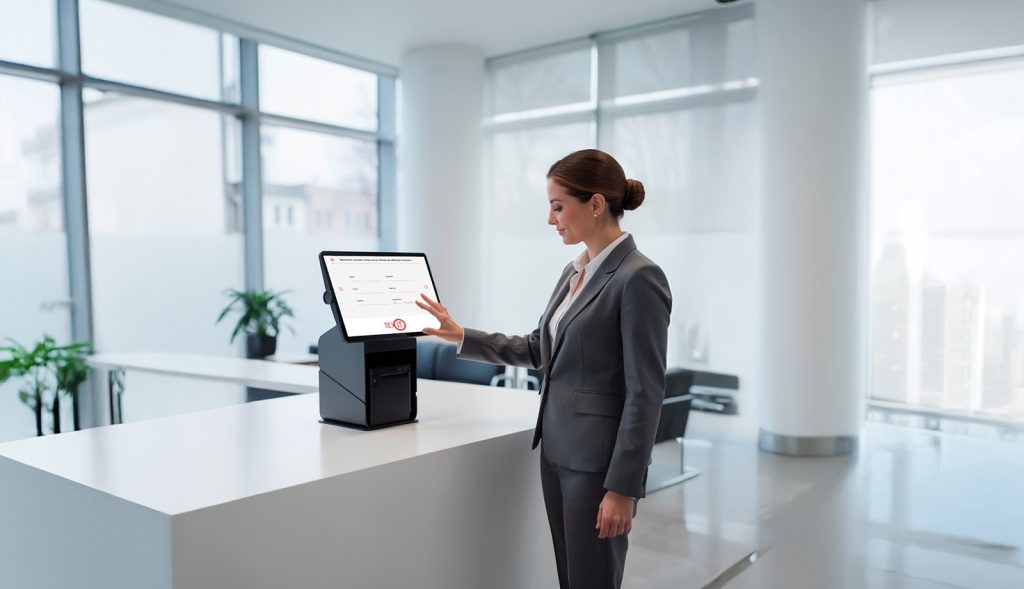
Varco Kiosk: from reception to informed control
Kiosk Varco was born from a concrete need:
to transform reception from a weak point to an element of control and security.
It’s not just a simple digital check-in system.
It’s a system designed for:
- structured companies
- multiple locations
- environments where security, responsibility, and compliance really matter
Technology is not the end.
It’s the means to reduce friction and increase awareness.
Reception is not courtesy. It’s governance.
Welcoming well isn’t just about being kind.
It means knowing what’s happening within your organization.
When welcoming is designed as a system:
- it improves the experience
- it increases security
- it reduces risks
- it simplifies work
And above all: it works even when it’s really needed.
 |
A discussion, before any solutionIf you’re rethinking how you manage access and reception in your company, a discussion can help clarify priorities and critical issues. |
|
A comparison, before any solutionIf you’re rethinking how you manage access and reception in your company, a discussion can help clarify priorities and critical issues. |