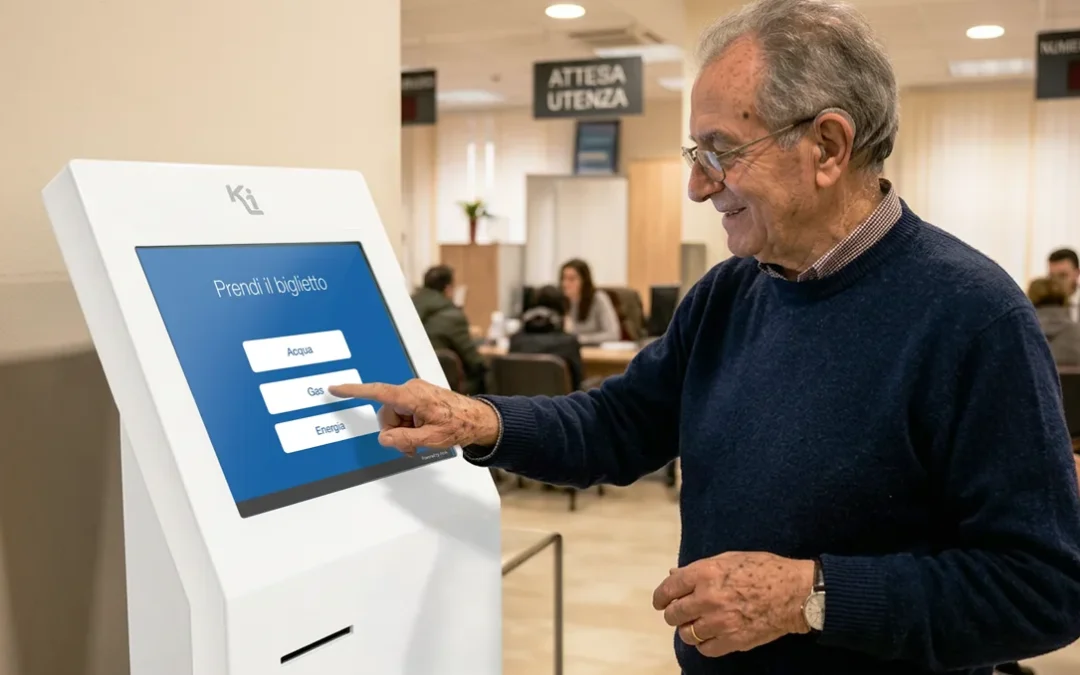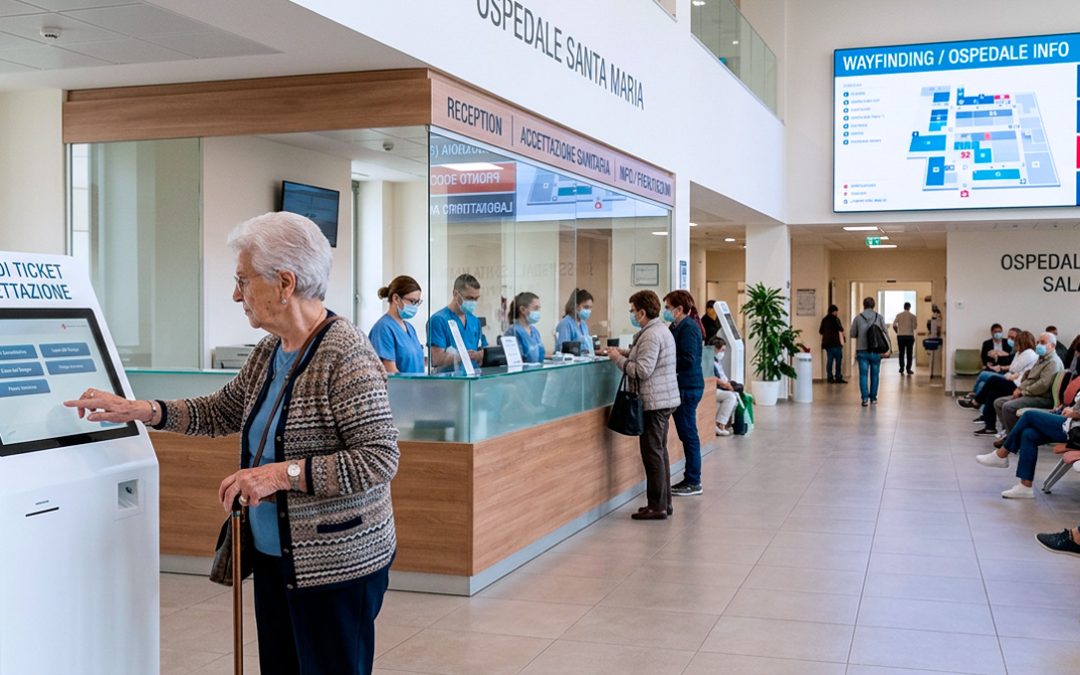
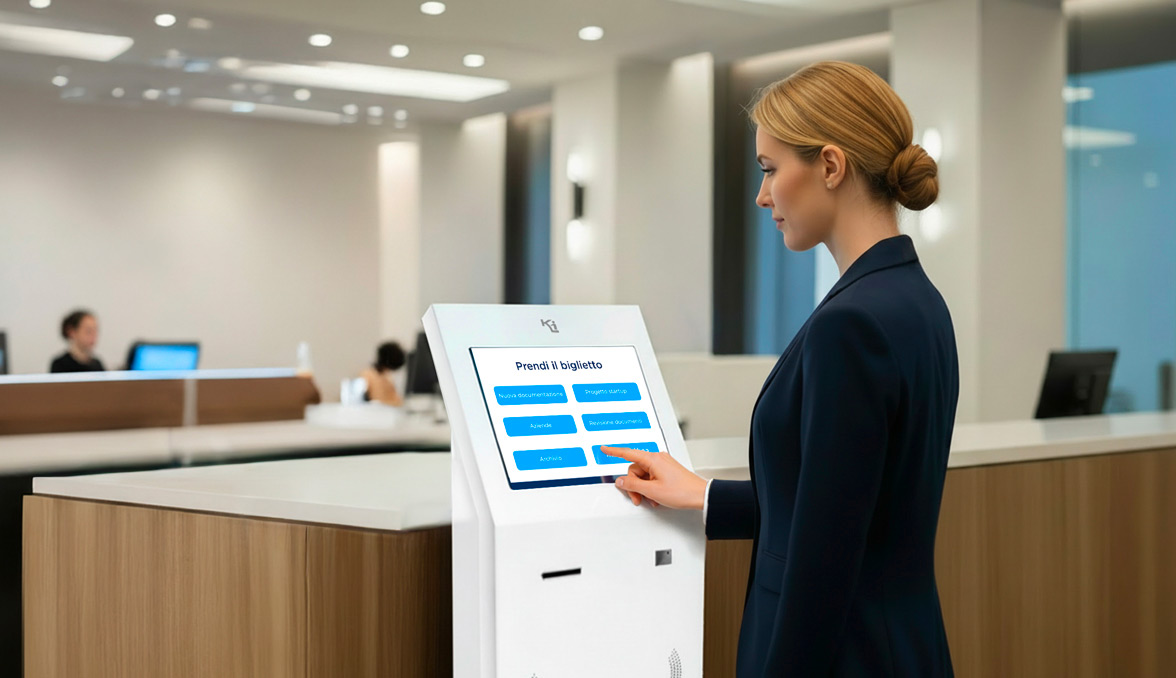
In every space open to the public, there’s a delicate, often underestimated moment: the wait.
It’s not just a moment of time, but a true experience, which impacts the perception of the service, people’s mood, and, in many cases, the reputation of the place itself.
In recent years, due to increased traffic, reduced staffing, and the growing expectation of fast and orderly service, the queue management totem has transformed from a technical solution to a design tool.
It no longer serves merely to “create order,” but to create a coherent, understandable, and reassuring experience.
According to various industry analyses, poor queue management can increase the negative perception of a service by up to 30–40%, even when the service itself is of high quality.
The point, therefore, is not just how much people wait, but how they wait, in what kind of space they wait, with what visual cues, with what degree of clarity and comfort.
It is precisely within this designed waiting space that the queue management totem finds its natural place.
Designing the waiting space: from wasted time to designed time
In many projects, the waiting space arises as a consequence. A residual area, a widened corridor, a few seats placed along the path.
Yet it is precisely there that a significant part of the user experience is concentrated.
In recent years, the design of the waiting space has become a central theme for architects, interior designers, and service planners.
It’s no longer just a matter of “where to make people wait,” but how to accompany them through a delicate moment in their journey.
Studies on the customer journey show that a wait perceived as disorganized or unclear negatively impacts the overall evaluation of the service, even when the final service is high-quality.
On the contrary, a clear, orderly, and guided space reduces stress, improves mood, and increases tolerance for waiting time.
Designing a waiting space well therefore means working on multiple levels:
- orientation, to avoid uncertainty and clutter
- legibility, to make it immediately clear what to do and where to go
- comfort, physical and psychological
- aesthetic coherence, because even the wait communicates the value of the place
In this context, the queue management totem is not a simple operational tool, but becomes a design hub: it organizes flows, gives rhythm to the space, and establishes a visual and functional hierarchy.
When the waiting area is designed together with the queue management system, the result is not only greater efficiency, but a sense of control and clarity that radically improves the overall experience.
The queue management totem as an architectural element, not an accessory
In contemporary projects, especially in the retail, corporate, and healthcare sectors, every object in the space contributes to defining the place’s identity.
A queue management totem is no exception: it is an integral part of the Digital queue management systems designed to improve flow management and the customer experience.
Including a featureless, out-of-scale, or aesthetically inconsistent device is equivalent to introducing a jarring note into a harmonious design.
On the contrary, when the totem is conceived as part of the architectural language, it becomes a natural reference point: it orients, reassures, and guides.
Architects and designers know it well: a well-designed object needs no explanation.
It’s self-explanatory because it respects proportions, interacts with materials, and is positioned at the right point along the customer journey, exactly as happens in the best digital kiosk projects for the customer experience.
This is why today, queue management kiosks are increasingly being incorporated into the initial phases of a project, rather than as last-minute additions.
Materials, stability, and safety: what makes a truly professional product
There’s a substantial difference between a totem designed to “just be there” and one designed to last.
A professional queue management totem must meet very specific needs:
withstand intensive use, maintain stability in crowded environments, and ensure safety even in delicate situations.
This is why the choice of materials is crucial.
Metal structures, solid bases, industrial components: these are details that often aren’t immediately noticeable, but that emerge over time.
As is attention to accessibility, which is essential not only to comply with regulations but to offer a truly inclusive service.
An unstable, lightweight, or plastic totem may seem like a quick fix, but in the medium term, it generates costs, maintenance, and problems that impact the overall experience.
These are the same principles found in professional multimedia kiosks, where robustness and build quality are an integral part of the digital signage strategy.
Software as the invisible infrastructure of the experience
Behind every good queue management kiosk is a software system that works silently.
This is where much of the value lies.
An advanced platform like Kiosk Hydra doesn’t just manage sequential numbers, it organizes flows, distributes priorities, integrates different services, and provides useful data for improving organization.
In complex contexts—think of a healthcare facility, a high-traffic retail outlet, or a corporate office with multiple counters—the difference between a simple and an advanced system is measured in:
- reduction in perceived time,
- less stress for staff,
- greater end-user satisfaction.
The software thus becomes a true invisible architecture, supporting the experience without imposing itself.
When this infrastructure communicates with a digital signage software platform, the queue management system becomes a fully-fledged part of an integrated communications ecosystem.
Queue eliminators and digital signage: informing, guiding, and making the most of time
Waiting, if well-managed, can transform into a valuable experience.
This is where the integration of queue management kiosks and digital signage comes into play.
Information screens, contextual messages, dynamic content: while the system manages the queue, communication accompanies the user.
This approach reduces the perception of time and increases the quality of the experience.
According to studies on the customer journey, clear and consistent communication during the wait can reduce the negative perception of time spent by up to 25%.
This fact explains why more and more projects integrate queue management and visual communication into a single system, often combining queue management kiosks with other interactive kiosks for in-store engagement.
Made in Italy design: when design meets the supply chain
Many queue management kiosks on the market are standard products, often imported, designed to adapt to any context without truly belonging to any one brand.
The result is a functional object, but lacking an identity.
Kiosk solutions, on the other hand, are born from an Italian design culture, where design, production, and support are part of the same vision.
This means construction quality, attention to detail, the possibility of rapid intervention, and product continuity over time.
In a major project, this reliability is not a plus: it is a necessity, the same one that also guides the information totem projects for territorial communication and for museums and galleries.
Kiosk One and Kiosk Nice: uncompromising robustness and design
For those seeking a queue management kiosk that combines aesthetics, solidity, and customization options, Kiosk One Small and Kiosk Elegant represent a rare combination.
They are also popular solutions in contexts designed by architects, where each element must interact coherently with the space and the overall language of the environment.
RAL colors, meticulous finishes, balanced volumes: the kiosk doesn’t impose itself, but integrates seamlessly, becoming a natural part of the project.
It’s this combination of build quality, attention to design, and long-term reliability that makes Kiosk One and Kiosk Nice high-end benchmarks in the world of queue management kiosks.
A partner that guarantees continuity and return on investment
Supplying queue management kiosks for years means understanding the product’s life cycle, not just the installation stage.
Software updates, assistance, spare parts, and project support: these are elements that make a difference in the long run.
Those who invest in a Kiosk solution choose a partner that doesn’t “experiment,” but builds systems designed to last.
And this is what guarantees a high ROI, not only in financial terms, but also in terms of reliability and management peace of mind.
The synthesis of function, design, and customer experience
A well-designed queue management kiosk doesn’t just eliminate lines.
It reduces friction, makes the service clear, and improves the relationship between people and space.
When functionality, design, and technology work together, waiting stops being a problem to be managed and becomes an experience to be designed.
And it is precisely in this synthesis that quality projects are recognized.
When the design matters, even discussion makes the difference
Every space has its own dynamics, its own flows, its own critical issues.
This is why there are no absolute solutions, but rather the right design choices for a specific context.
If you’re working on a project where managing queues, flow, and customer experience is a key focus, a clarification call can be the first step to understanding whether—and how—a Kiosk queue management system can truly integrate into your space.
An open, no-obligation discussion is useful for sharing needs, constraints, and objectives before even discussing solutions.
Request a clarification call and together we’ll evaluate the best approach for your project.
 |
Schedule a callAn open, no-obligation discussion, useful for sharing needs, constraints, and goals before even discussing solutions. |
|
Schedule a callAn open comparison, without Commitment, useful for sharing needs, constraints, and goals before even discussing solutions.
|