Improving the hospital patient experience doesn’t mean beautifying a waiting room or adding a screen in the hallway.
It means addressing something much more delicate: the sense of control.
When a person enters the hospital, they are rarely at peace. They may be worried about a test, tired, anticipating a procedure, or simply disoriented. In those first few minutes, the questions that shape the entire experience arise:
- Do I understand where to go?
- Am I doing the right thing?
- Will they call me?
- How long will I have to wait?
If these questions remain unanswered, anxiety grows.
If, on the other hand, the path is clear, the experience changes radically—even with the same waiting time.
This is why improving the patient experience in the hospital means designing a system that reduces uncertainty, disorientation, and information overload.
Patient experience is not a “soft” detail
When we talk about the patient experience in the hospital, we tend to think of a “relational” issue. In reality, it’s an organizational issue.
The experience is the visible effect of:
- how the flows are structured
- how clear the information is
- how legible the space is
- how predictable the process is
A hospital can offer clinical excellence, but if the patient feels lost, the perceived quality drops.
And there’s an important insight:
👉The perceived wait weighs more than the actual wait.
A wait without information seems endless.
An explained and orderly wait is accepted.
The first impact: eliminating uncertainty
Many problems arise in the first five minutes.
If the entrance is unclear, if the check-in process is confusing, if the next step isn’t clear, the patient enters a state of uncertainty that stays with them throughout the entire journey.
And it is precisely in this phase that a fundamental part of the hospital patient experience plays out.
A key aspect is orientation in complex spaces. When pathways aren’t immediately clear, disorientation generates anxiety and increases the number of requests to staff.
We explored this topic in more detail in the article dedicated to digital wayfinding in hospitals.
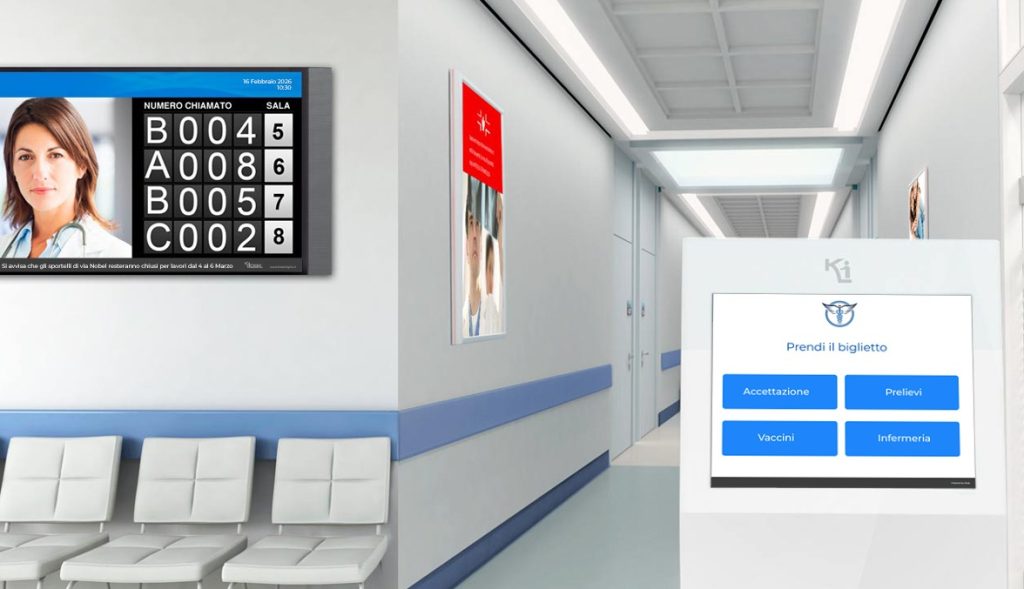
In this context, a digital concierge system for healthcare facilities, such as Kiosk Live Hospital, is not a simple information totem, but a tool that structures the initial dialogue between patient and organization.
It doesn’t replace staff: it makes them more effective.
It allows for immediate directions, clarification of procedures, guidance to the correct department, and less burden on the information desk, transforming the entrance from a moment of uncertainty to a clear orientation point.
The difference lies not in the technology itself, but in reducing organizational and perceptual friction.
Waiting management: transforming the most critical moment
Waiting is the point of greatest emotional tension.
When there’s no orderly system, the same things always happen:
- The patient constantly asks, “Where are we at?”
- The staff pauses to answer
- It creates widespread nervousness
Waiting management also significantly impacts the perception of service. We discuss this in our in-depth article on queue management in medical clinics.
A digital waiting management system in hospitals, like Kiosk Hydra, completely changes the dynamic.
Not because it magically reduces time, but because it introduces:
- order
- predictability
- visibility of one’s turn
This has a powerful psychological effect: the patient feels that there is a criterion.
And when a criterion exists, stress is reduced.
Providing information while waiting: the role of digital signage
Another common mistake is thinking that the screen is only for calling numbers.
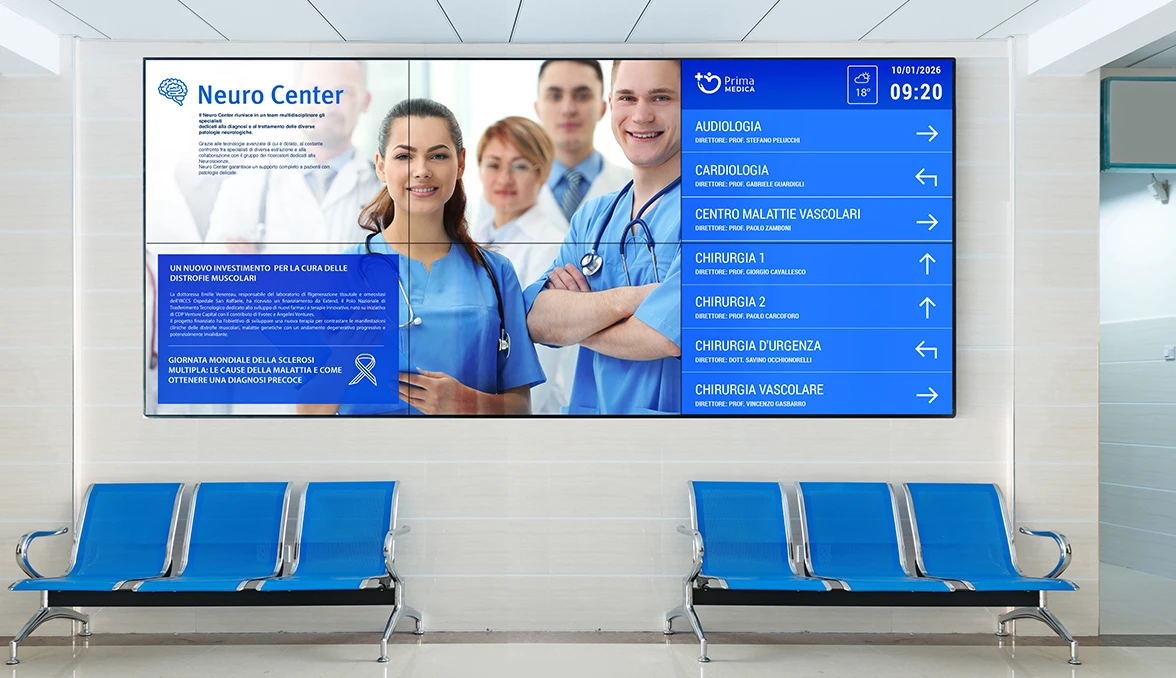
In reality, hospital digital signage software is a strategic communication tool.
While waiting, you can:
- explain procedures
- clarify what happens after the visit
- provide preventive instructions
- reassure with simple language
Information reduces the fear of the unknown.
And here’s another important insight:
👉 clarity reduces repetitive questions at the front office.
Fewer basic questions means more time for real listening.
Orientation: reducing invisible disorientation
Hospitals are complex environments.
Corridors, floors, clinics, departments with technical names.
Disorientation isn’t always obvious, but it significantly impacts the experience.
An integrated system that combines:
- consistent signage
- interactive totems
- coordinated content via digital signage
- concierge support
allows you to transform a complex space into a legible path.
And when the path is legible, the facility is perceived as organized.
Measure to truly improve
Many healthcare facilities invest in tools to manage patient flow and wait times, but neglect a crucial step: measuring the real impact on the patient experience.
Without data, experience remains a perception.
With data, it becomes a management indicator.
Real-time satisfaction monitoring, through immediate feedback systems like Kiosk Emoticon, allows you to intercept signals that would otherwise remain invisible: a department with perceived longer waits, a critical time slot, a recurring reception problem.
This allows you to:
- identify specific critical issues
- compare departments objectively
- rapidly address micro-operational frictions
- transform satisfaction into a measurable KPI
Improving the hospital patient experience is not a one-off project.
It is a continuous process of observation, analysis, and optimization.
And the difference between a reactive structure and an advanced structure lies precisely here: in the ability to listen in a structured way.
Technology and Staff: a false opposition
The idea still exists that digitizing means “dehumanizing.”
In reality, the opposite happens.
When systems like:
- queue management kiosks
- digital concierge
- centralized communication
work properly, staff stops managing repetitive micro-problems and can focus on what really matters: listening, empathy, reassurance.
Technology does not replace relationships.
It protects them from overload.
An integrated system, not isolated tools
The most common mistake is introducing individual solutions without a systemic vision.
A kiosk alone does not improve the experience.
A screen alone doesn’t reduce anxiety.
It’s the integration of:
- digital queue management (Kiosk Hydra)
- concierge and orientation (Kiosk Live Hospital)
- centralized communication (digital signage software)
- customer satisfaction survey (Kiosk Emoticon)
that creates consistency.
And consistency is what generates trust.
Conclusion: Improving the patient experience means designing
When we talk about improving the patient experience in the hospital, we’re not talking about comfort.
We’re talking about flow design, reducing uncertainty, and clear communication.
A hospital perceived as orderly and legible is a hospital perceived as competent.
And today, in healthcare, perceived competence matters almost as much as technical expertise.
FAQ
How can we concretely improve the patient experience in hospital?
To improve the patient experience in hospital, three main areas must be addressed: waiting time management, orientation, and clear communication throughout the process. The introduction of digital queue management systems, informative concierges, and digital signage communication reduces uncertainty and improves the overall perception of the service.
How can we reduce patient complaints in hospital?
To reduce complaints, it is necessary to address the recurring causes: unexplained wait times, unclear information, and difficulty finding your way. Digital waiting time management, clear communication via digital signage, and guided orientation tools reduce frustration and lower the number of complaints to staff.
How much does the patient experience impact a hospital’s reputation?
It has a significant impact. A healthcare facility’s reputation depends not only on clinical quality, but also on the perceived organization, clarity, and patient care. A confusing or stressful experience negatively impacts reviews, word of mouth, and long-term trust.
Does patient experience also impact internal efficiency?
Yes. When the experience is structured, interruptions at the front office are reduced, repetitive requests are reduced, and staff can focus on higher-value activities. Improving the hospital patient experience is therefore also a strategic organizational decision.
How can we better organize hospital reception?
An effective reception is based on clear initial steps, orderly flow management, and immediate information support. The integration of digital concierge, queue management systems, and centralized communication makes the entrance easier to understand and reduces disorientation and repetitive requests.
Why is perceived wait time more important than actual wait time?
Perceived wait time directly impacts patient stress levels. When waiting times are unknown or the order of waiting is misunderstood, the wait seems longer than it actually is. Digital wait management systems make the process visible and predictable, reducing anxiety even when the actual wait time remains the same.
Is digital signage in hospitals just for calling numbers?
No. Hospital digital signage can play a strategic role in communication. Beyond calling numbers, it can inform patients about procedures, clarify what happens after the visit, provide prevention tips, and reduce the number of repetitive requests to the front office.
Do self-service kiosks replace healthcare staff?
No. Kiosks and digital systems do not replace staff, but they automate repetitive and informative tasks. This allows staff to dedicate more time to situations that require empathy and human support.
What are the main mistakes when trying to improve the patient experience?
The most common mistake is introducing digital tools without an integrated plan. A single kiosk or isolated screen will not improve the experience if it is not integrated into a coherent system for flow management, communication, and orientation.
How can we measure whether the patient experience is truly improving?
The experience can be monitored through immediate feedback systems, wait time analysis, reduction of repetitive requests at the information desk, and flow observation. Continuous measurement allows for rapid intervention and progressive improvement.
What is the first step for a hospital that wants to improve the patient experience?
The first step is to analyze the points of friction: entry, admission, waiting, and orientation. Before introducing digital tools, it is essential to map the flows and understand where uncertainty and stress are generated.
 |
Want to learn more?Seize this innovation opportunity and contact us today. Your hospital’s transformation starts with one simple step. |
|
Do you want to know more?Seize this opportunity for innovation Contact us today. Your hospital’s transformation starts with one simple step.
|