
In Italy, patient-perceived quality has become an institutional priority. The National Recovery and Resilience Plan dedicates significant resources to the digital transformation of healthcare, and the Ministry of Health has long since included measuring patient experience among the quality indicators of hospital services.
Yet in most healthcare facilities, patient feedback is still collected with a paper questionnaire distributed upon discharge—completed long after the experience is complete, often hastily, and almost always by a minority of patients.
The result is poor, delayed, and poorly representative data. Not enough to make operational decisions. Not enough to truly improve.
What is meant by patient experience and why we should measure it
Patient experience is not patient satisfaction in the generic sense. It is the sum of the concrete interactions a person has with the healthcare system throughout their treatment journey: the welcome at reception, wait times, the clarity of information received, the quality of the relationship with staff, the cleanliness of the facilities, the ease of orientation within the facility.
Measuring it has a value that goes beyond institutional courtesy. Facilities that collect and act on patient feedback achieve measurable results: a reduction in formal complaints, improved therapeutic compliance, increased trust in the facility, and—in an increasingly competitive environment between public and private facilities—a better ability to attract and retain patients.
The Limitation of traditional questionnaires: the problem of recall bias
The main flaw of questionnaires administered upon discharge is recall bias: memory of the experience deteriorates rapidly and is influenced by the patient’s current mood, current health status, and the outcome of the hospitalization.
A patient who has had a long wait in the emergency room but an excellent hospital stay will tend to rate the entire experience positively upon discharge. Conversely, a patient discharged with an uncertain outcome will also rate aspects of the service that initially satisfied them negatively.
This doesn’t mean that traditional questionnaires are useless—but it does mean that they alone aren’t enough. We need tools that capture feedback as the experience occurs, before memory filters and reinterprets it.
Instant feedback: what it is and why it works best
An instant survey is a short, simple, and timely survey administered immediately after a specific interaction: leaving an outpatient appointment, going to the cashier, completing a diagnostic test, or leaving the waiting room.
There are three characteristics that make it effective in healthcare.
- Brevity: one or two questions at most. The patient doesn’t have to fill out a form—they have to express a concise opinion in a few seconds. The response rate of a well-designed instant survey is significantly higher than any traditional questionnaire.
- Immediacy: Feedback is collected while the experience is still fresh. The data reflects the reality perceived in the moment, not a retrospective reconstruction.
- Localization: Each survey is associated with a specific touchpoint in the patient journey.
The “hospital experience” isn’t measured generically—it’s measured how the patient experienced the waiting room in the cardiology department, or the CUP desk in Pavilion B. This allows us to precisely identify where to intervene.

Patient Journey Touchpoints: where to place the survey
The hospital patient journey comprises very different phases, each with its own challenges and opportunities for listening.
Metrics: CSAT, NPS, and CES in healthcare
Standard customer experience metrics are well suited to the healthcare context, with some specifics to keep in mind.
The CSAT (Customer Satisfaction Score) measures immediate satisfaction with a specific interaction. It is the most suitable metric for specific surveys at individual touchpoints: “How did you rate the service you received today at the CUP?” On a scale of 1 to 5, or with emoticon icons that further simplify the response, the CSAT provides immediate and comparable data over time.
The NPS (Net Promoter Score) measures the propensity to recommend a facility. In healthcare, it should be used with caution: the recommendation of a hospital depends on variables beyond the quality of service (geographical proximity, access to the National Health Service, specialization).
The NPS is more useful in private facilities or in services that compete directly with private providers, where patient choice is more open.
The CES (Customer Effort Score) measures the ease with which a patient completed an interaction: finding the department, scheduling a follow-up appointment, obtaining administrative information. It is a particularly relevant metric in complex facilities where orientation and administrative processes are often a source of frustration.
For more information and examples, we also invite you to read:
👉 How to measure customer satisfaction
👉 How to measure satisfaction to retain customers
Italian legislation on quality assessment in healthcare
In Italy, assessing perceived quality in healthcare facilities is not just a good practice: it is the subject of specific regulatory and institutional guidelines.
Legislative Decree 502/1992 and subsequent amendments introduced the principle of patient-centeredness and the obligation for accredited facilities to adopt systems for assessing perceived quality. The regions have then implemented these principles in different ways, with some regional systems for systematically assessing patient experience.
The National Quality Plan and institutional accreditation criteria require healthcare facilities to document their patient engagement activities and demonstrate how the feedback collected has fueled improvement actions.
It is not enough to collect data: it is necessary to demonstrate that that data is being used.
In this context, having a platform that archives findings, produces periodic reports, and allows tracking corrective actions taken isn’t just a competitive advantage—it’s an increasingly expected requirement during accreditation and audits.
How Kiosk Emoticon works in hospitals
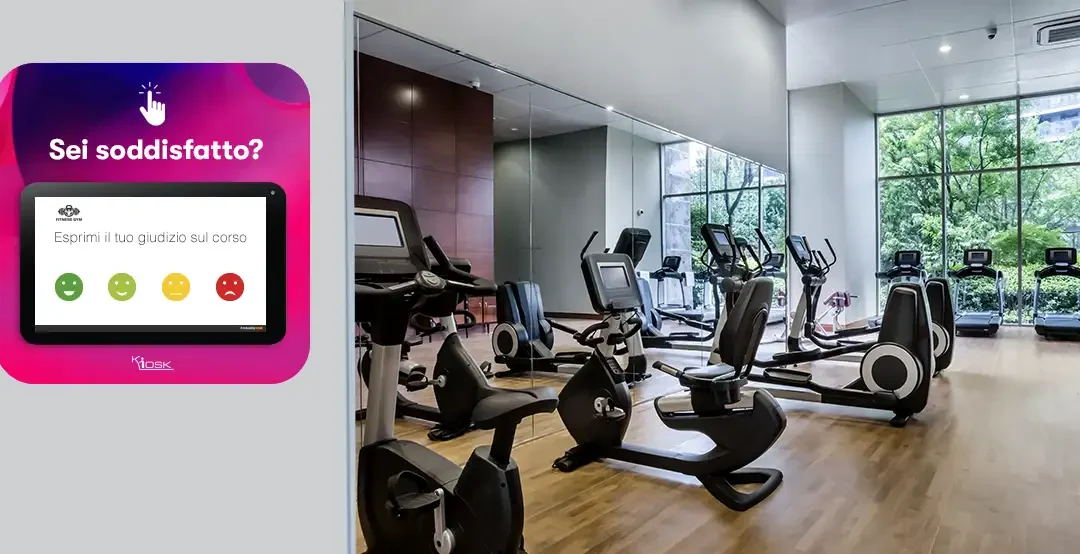
Kiosk Emoticon is Kiosk’s solution for instant satisfaction measurement. It is implemented on tablets, touch screen kiosks, or dedicated displays, positioned at strategic points along the patient journey.
The patient sees a simple question and responds by touching the emoticon that best represents their experience—in just a few seconds, without having to fill out any form. If the facility deems it appropriate, the response can be followed by a second question to identify the reason for dissatisfaction or satisfaction: an additional level of detail without compromising the simplicity of the interaction.
All data flows into a centralized administration panel, where you can view satisfaction trends over time, compare results across different departments and touchpoints, identify dissatisfaction peaks, and correlate data with operational variables such as days of the week or time slots.
The platform supports the main measurement indicators—CSAT, NPS, and CES—and allows you to design different surveys for different touchpoint types, with the flexibility to modify them at any time without technical intervention.
From data collection to action: the true value of measurement
Collecting feedback is just the first step. The real value of patient experience measurement lies in the ability to transform data into operational decisions.
A facility that systematically measures satisfaction across individual touchpoints can identify a decline in the perception of a specific service in real time—and intervene before it turns into a formal complaint or a loss of trust.
It can compare the performance of different departments, share internal best practices, and motivate staff through positive data.
Above all, it can demonstrate—to patients, institutions, and accrediting bodies—that listening isn’t a declaration of principle but a structured and ongoing practice.

Vuoi saperne di più?
Prenota una demo gratuita.