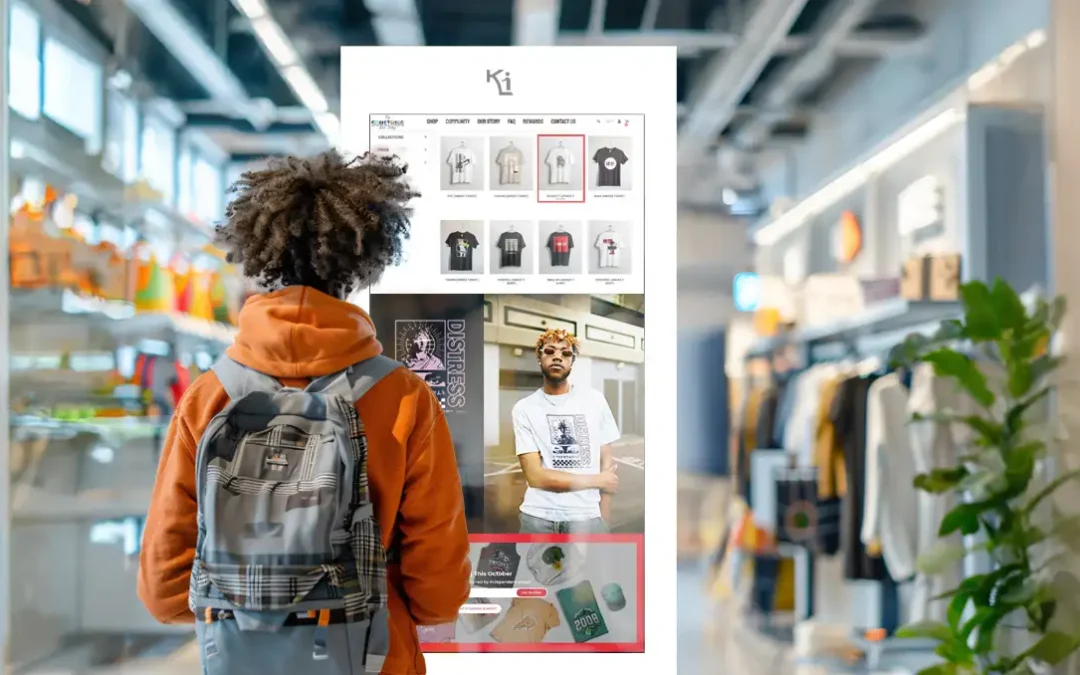
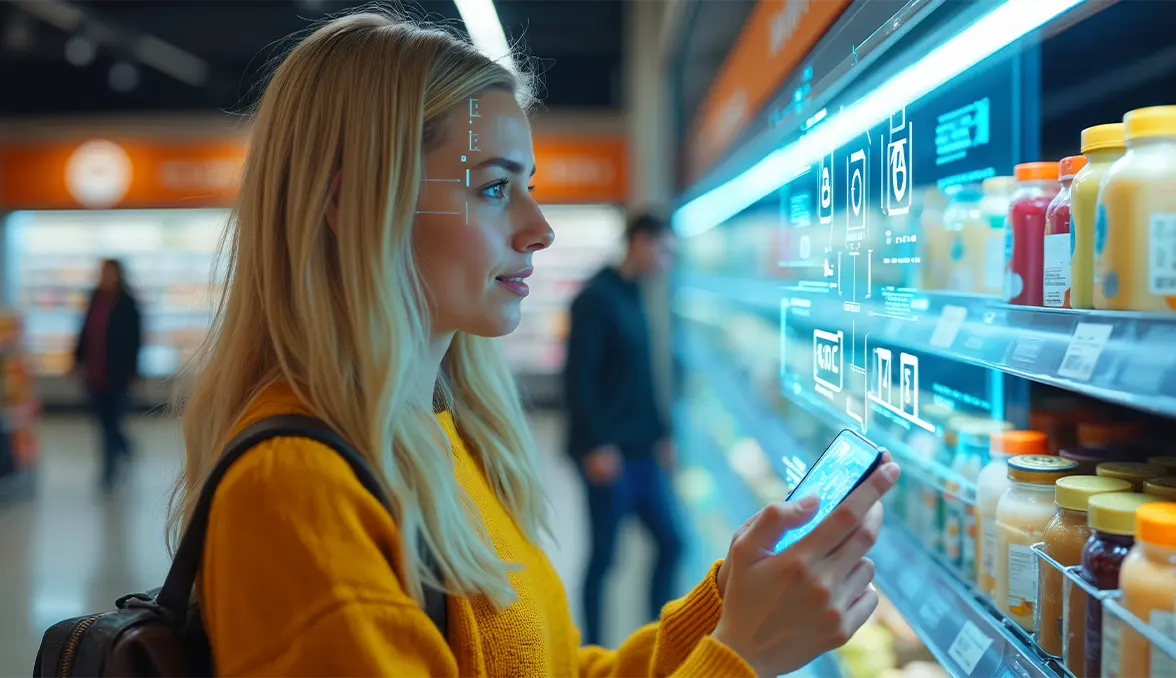
In contemporary retail, purchasing decisions are made in a matter of seconds.
Often, not in response to a promotion, but in front of the shelf.
In a context saturated with visual stimuli and competing messages, the shelf is no longer a simple display area: it has become a strategic touchpoint, capable of guiding—or blocking—a choice.
Research on purchasing behavior indicates that a shopper dedicates very little time to evaluating a product, with an attention span that can drop below three seconds for a single item. This extremely short window decides the outcome of a campaign: being noticed, being understood, being chosen.
Research indicates that up to 70% of purchasing decisions are made in-store, within just a few seconds of being in front of a shelf.
This is why, today, the true competitive advantage is not shelf presence, but the ability to stand out, be understood, and guide a choice in a matter of seconds.
This is where experiential corners with digital totems and digital signage systems come into play: spaces designed to transform the shelf into a narrative point, capable of providing context to the product, conveying brand values, and generating measurable interactions directly at the point of sale.
Why digital experience determines shelf selection
Consumer product marketers know it well:
- The average attention span at the shelf is low
- Pricing is often similar among competitors
- Packaging alone is no longer enough to differentiate
Experience therefore becomes the decisive factor. A well-designed digital corner allows you to:
- increase the time spent in front of the product
- clearly explain the benefits, ingredients, origin, and use
- transmit brand values that would never fit on packaging
It’s not about “adding a screen,” but about designing a micro-narrative consistent with the brand and the sales context.
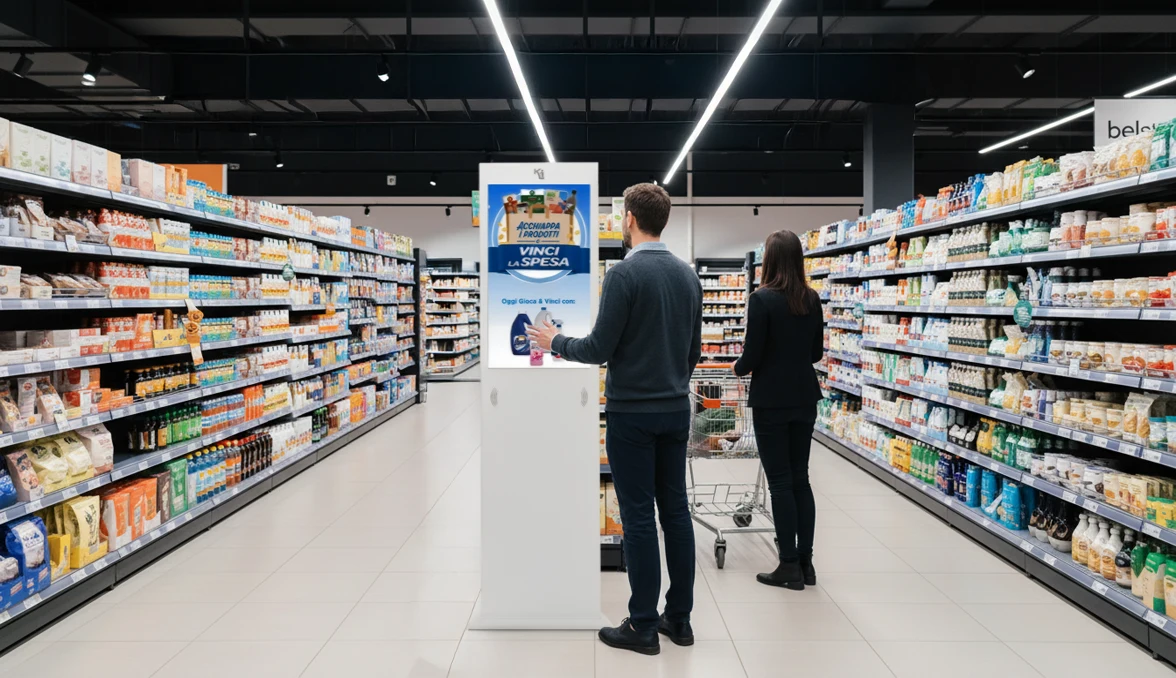
From static shelf to communication platform
A common mistake is to think of digital signage as a simple video medium. In practice, an effective digital shelf functions as a miniature editorial platform, integrated into the brand’s omnichannel journey.
The best-performing content in large-scale retail is often:
- Short, visual storytelling (30–60 seconds)
- Focus on a single key benefit
- Repeatable and recognizable formats
- Content adapted to the point of sale (not “recycled” from advertising or TV)
Content design is an integral part of the project: without a clear narrative strategy, even the best technology remains silent. The most mature projects treat the corner as a permanent A/B test of creativity, formats, and promotions, continuously measuring what really works.
In-store insights: when the point of sale becomes a data source
One of the greatest advantages of digital corners is the ability to gather real insights, directly from where the decision is made.
In a context where traditional research is often episodic and costly, insights gathered directly in the aisle allow us to complement “sample” research with continuous measurement of real, in-the-field behavior.
Interactive kiosks for quick surveys allow you to:
- test the popularity of a new product
- compare flavor, packaging, or messaging variations
- collect immediate and spontaneous feedback
- measure real, not estimated, engagement
This data, especially when collected continuously across multiple brands, becomes a valuable basis for category management and trade marketing decisions, much closer to the reality on the shelf than sell-out data alone.
In our experience, even a single, well-designed question can provide more useful insights than many post-campaign surveys: the value lies not only in the data, but in the continuity of the measurement: same format, same KPIs, different points of sale.
Phygital Projects: Coherently Integrating the Physical and Digital
The real leap in quality occurs when the corner isn’t an island, but part of an ecosystem.
 The most effective Phygital projects integrate:
- QR codes on pack that unlock exclusive content
- Digital coupons linked to in-store interaction
- Dedicated landing pages to extend the experience to the home
- Integration with CRM and marketing systems
The most advanced implementations treat the corner as a piece of the omnichannel journey: the same storytelling is applied across advertising, social media, e-commerce, and point of sale, ensuring message consistency and greater memorability throughout the customer journey.
In this way, the point of sale generates data, marketing enhances it, and the brand builds a relationship that goes beyond the shelf.
Technology is the medium. Strategic direction makes the difference.
Field experience: what really works
In brand awareness projects carried out in large-scale retail outlets with interactive mini-quizzes, we have observed recurring patterns:
- Simple mechanics beat overly complex experiences
- Interaction works if it lasts a few seconds
- Content must be self-explanatory
- Technology must be invisible
These patterns are also reflected in the literature on digital signage, which highlights how short, focused content increases dwell time and message memorability compared to static materials.
In one such project, developed for a major Italian food brand (with well-known experience in the sector), the goal was not to sell immediately, but to strengthen product memorability.
The result was engagement beyond expectations and a significant increase in exposure to the brand message.
In similar, documented retail projects, digital signage solutions have generated increases in display time of up to approximately 30% and improved message recall by over 20 percentage points compared to traditional communication, confirming the experiential lever as a concrete driver of results.
Kiosk: project know-how, not just technology
In complex contexts like large-scale retail trade, the greatest risk is approaching the project in silos:
- who supplies the hardware
- who produces the content
- who (perhaps) measures the results
Kiosk works differently, positioning itself as a project partner, not just a supplier.
Kiosk works differently, positioning itself as a project partner, not just a supplier. We support marketing teams in a structured process: flow and context analysis, in-store experience concept, prototyping, field testing, and scalable rollouts.
We support brands in:
- Concept and design of the in-store experience
- Definition of KPIs (not just “likes” or views)
- Choosing the most suitable technologies for the real-world context
- Content and interaction design
- Rollout to: large-scale retail, perfumery, specialty retail, export projects
Our value lies not in a single totem, but in our ability to make the entire system work and to communicate with both brand teams and distribution brands for shared projects.
Conclusion
Experiential corners aren’t a fad. They’re a concrete answer to a real problem: how to stand out and make a mark in the most competitive space of all: the shelf.
For consumer product marketing managers, today the challenge isn’t choosing whether to invest in the experience, but how to design it well, with method, creativity, and measurability.
Because in contemporary retail:
- Those who design the experience capture attention
- Those who measure it build value
- Those who scale build competitive advantage
And that’s exactly where real know-how is born.
FAQ – Experiential corners and digital shelves in large-scale retail
1 – What are experiential corners in large-scale retail?
Experiential corners are dedicated spaces within the store designed to enhance products or brands through digital content, visual storytelling, and guided interactions. They don’t just display a product; they contextualize it, explain its value, and guide the customer through their choice directly on the shelf.
2 – Why has storytelling on the shelf become so important?
Because the purchasing decision in large-scale retail often occurs in a matter of seconds and in a stimuli-rich environment. Storytelling allows you to give meaning to the product, making it recognizable and memorable, helping the customer quickly understand why they should choose it over other available options.
3 – When do digital displays increase in-store engagement?
Digital displays are particularly effective when:
- they introduce new products or lines
- they explain complex features in a simple and visual way
- they strengthen brand positioning
- they accompany promotions or temporary launches
In these cases, digital does not replace the shelf, but enhances it, transforming it into a point of active interaction.
4 – What is the difference between a traditional shelf and a digital shelf?
The traditional shelf communicates primarily through packaging and pricing.
The digital shelf, on the other hand, adds layers of dynamic information: videos, animations, contextual messages, and updatable content that help the customer orient themselves and make a more informed decision.
5 – Do experiential corners only work for big brands?
No. Even emerging brands or niche products can benefit from experiential corners, especially when it’s necessary to explain the product’s value, origin, or use. In these cases, digital helps bridge the knowledge gap that often penalizes new products on the shelves.