Today’s pharmacy is no longer just a place to dispense medications.
It’s a place for consultation, prevention, services, and retail sales.
And precisely for this reason, queue management has become a strategic factor.
During peak hours—typically between 5:30 PM and 7:30 PM—the space fills up, customers approach the counter to avoid missing their turn, staff work under pressure, and the experience becomes tense.
A pharmacy queue management isn’t just an organizational tool.
It’s a system that impacts:
- quality of service
- professional perception
- average receipt
- staff management
- profitability
Let’s see how it really works and how much it costs.
What a pharmacy queue management system is (and what it isn’t)
Many people still think of it as a “number.”
There are actually 4 levels:
- Simple numbering system
- Multi-service queue management system
- Integrated platform with data analysis and digital signage
- Centralized cloud-based multi-site
A professional queue management system for pharmacies allows you to:
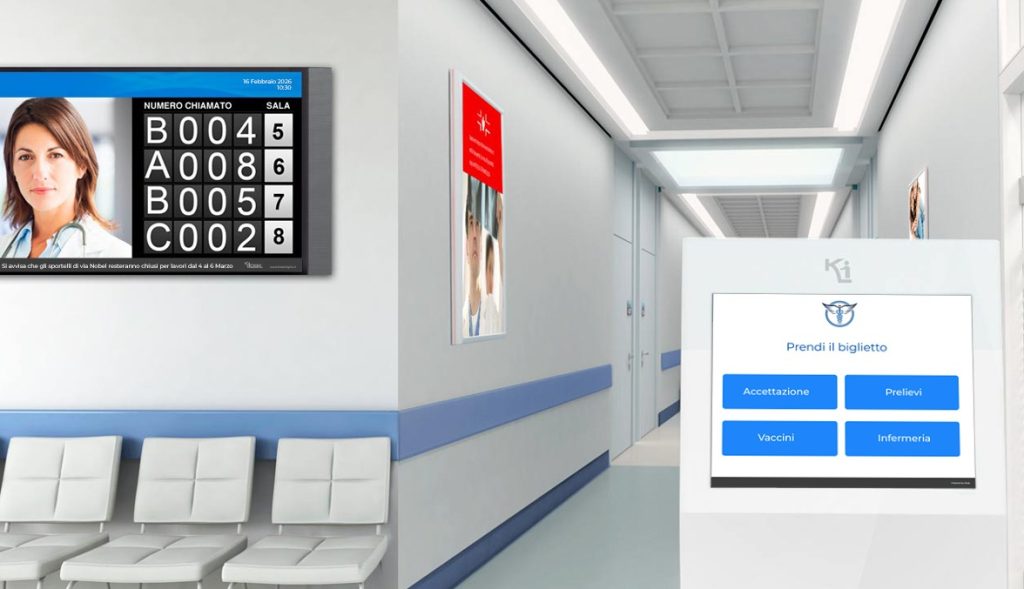
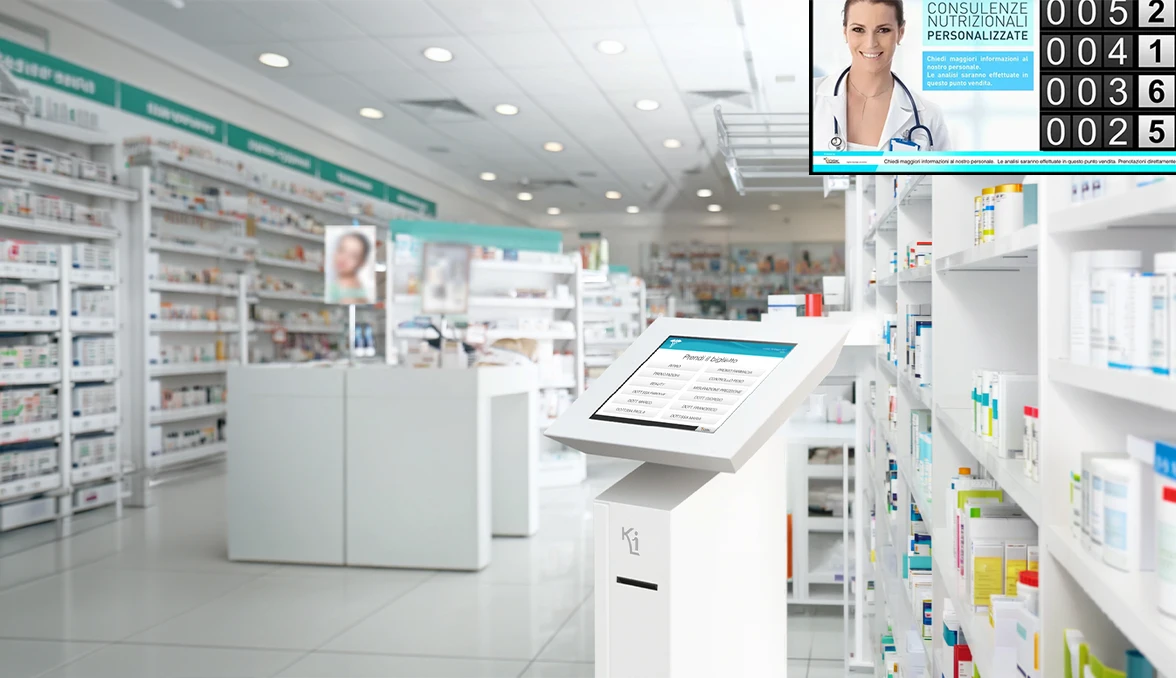
- Issue tickets by service type (prescriptions, consultations, CUP services, self-analysis)
- Manage priorities (elderly, emergencies, customers with reservations)
- Automatically route customers to the free counter
- View calls on the display
- Analyze average waiting and service times
- Manage customer reservations
It’s not just order.
It’s flow control.
Insight: why waiting affects sales
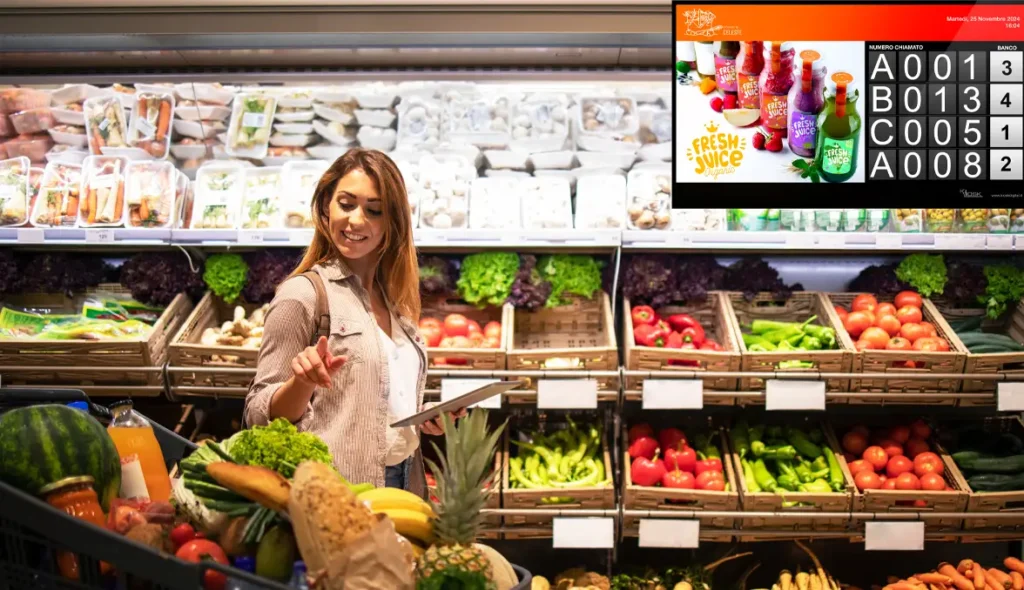
An often overlooked fact. When customers fear missing their turn:
- stays close to the counter
- avoids wandering away
- doesn’t explore the shelves
- reduces the time spent waiting
When they know they’ll be called automatically:
- moves freely
- observes products
- pays attention to the communication on the displays
- is more inclined to make additional purchases
Orderly waiting increases the “peaceful” waiting time.
And peaceful waiting time in retail is correlated with the average receipt.
Furthermore:
- reduces tension at the counter
- improves advice
- improves the perception of professionalism
Several retail studies show that disorganized queue management can reduce perceived satisfaction by up to 30–40%, even with the same actual service time.
Pharmacy queue management and multi-service management
Pharmacies today manage:
- NHS prescriptions
- OTC
- dermocosmetics
- swabs and vaccines
- CUP services
- self-analysis
Without a structured system, everything flows into a single physical queue.
With a professional system:
- flows are separate but coordinated
- priorities are configurable
- counter load is balanced
- staff work more efficiently
This is particularly important in urban pharmacies with 3 or more service stations.
Queue management solutions for pharmacies
Every pharmacy has different needs.
For small organizational needs: Qmicro Kiosk
Qmicro Kiosk is the essential solution for pharmacies and retail outlets with a single queue and a few counters.
Ideal for those who want to start structuring waiting times without complex systems.
Compact professional kiosk: Kiosk One Small
Kiosk One Small is a touch-based queue management kiosk:
- robust
- stable
- suitable for continuous use
- ADA compliant
- intuitive service selection
- integration with call display
Suitable for pharmacies with multiple services and the need for direct interaction.
Elegant and repositionable solution: Kiosk Elegante
Kiosk Elegant is the elegantly designed queue management kiosk, designed for sophisticated retail environments:
- service selection on touch display
- ticket printing
- multiservice display integration
- easy repositioning
Ideal for pharmacies with a strong focus on image and customer experience.
Data Analysis: The Real Competitive Advantage
An advanced system allows you to monitor:
- average waiting time
- average service time
- number of customers per time slot
- weekly peaks
- distribution by service type
- refined alert management
This allows you to:
- optimize staff shifts
- better plan promotional campaigns
- evaluate counter saturation
- make decisions based on real data
Making decisions based on data is very different from making them based on perception.
How much does a pharmacy queue management system cost?
This is one of the most frequently asked questions.
The price of a pharmacy queue management system depends on several factors:
- number of counters
- number of services to configure
- presence or absence of display advertising
- type of totem or transmitter
- basic or advanced software
- possible multi-location management
- level of customization
Generally speaking, there are:
- essential solutions for small pharmacies
- professional configurations for multi-service pharmacies
- centralized platforms for pharmacy networks
There is no standard price because no two pharmacies are the same.
A queue management system is not an off-the-shelf product.
It’s a project that needs to be tailored to the context.
When is it really worth installing one?
A queue management system is particularly suitable when:
- The pharmacy has 3 or more counters
- Customers at peak hours exceed 30
- Services beyond simple dispensing are available
- You want to improve organization and professional image
- You want to sell products beyond prescriptions
In these cases, the return on investment is not only organizational, but also commercial.
Pharmacy queue management: cost or investment?
The right question isn’t “how much does it cost.”
It’s:
How much does it cost me not to have one?
- Lost sales due to chaotic waiting times
- Operational stress
- Perception of disorder
- Inefficiency in staff management
The pharmacy is not just any store.
Here, customers don’t just buy a product: they discuss health, share personal information, seek professional advice, and are often in a vulnerable situation.
In this context, the environment plays a crucial role.
Every element—order, clarity, and wait management—contributes to building a perception of competence and reliability.
When the system is organized, uncertainty decreases, tension is reduced, and the customer perceives control and professionalism.
In organized retail settings, a more relaxed, untethered experience can have a positive impact on the average receipt, with variations in some cases exceeding 5–10%.
An organized environment reduces shift ambiguity, improves the perceived quality of service, and creates the conditions for lasting trust.
And trust, in the pharmacy, is the basis for loyalty.
Unfortunately, simply installing a cheap, often lightweight and unstable, totem isn’t enough to think you’ve solved queue management.
In the pharmacy, you can’t improvise.
An unstable system, with lightweight hardware and limited software, creates more disruptions than it solves.
Efficiency isn’t an option. It’s a requirement.
In the retail sector, poorly managed queues can reduce perceived satisfaction by up to 30–40%.
You can learn more about the technical features in the complete Kiosk Hydra data sheet, or discover how the platform integrates with booking tools and customer satisfaction systems in the article dedicated to advanced flow management and integration with Kiosk Book.
Conclusion
A pharmacy queue management system today is no longer an accessory.
It is a tool for designing the service experience.
From a basic solution like Kiosk Qmicro to professional kiosks like Kiosk One Small (ADA compliant) and Kiosk Elegant, the goal is the same: organize flows, improve the experience, and support profitability.
If you’re considering introducing a queue management system in your pharmacy, the first step isn’t choosing a model. It’s analyzing flows, spaces, and services.
Every pharmacy is different.
And the solution should be, too.
 |
Do you want to turn queue management into a competitive advantage for your pharmacy?Discover how a queue management system designed for pharmacies can improve operational efficiency, reduce wait times, and improve perceived service quality. |
|
Do you want to transform wait management into a competitive advantage for Your pharmacy?Discover how a queue management system designed for pharmacies can improve operational efficiency, reduce wait times, and enhance the perceived quality of service.
|