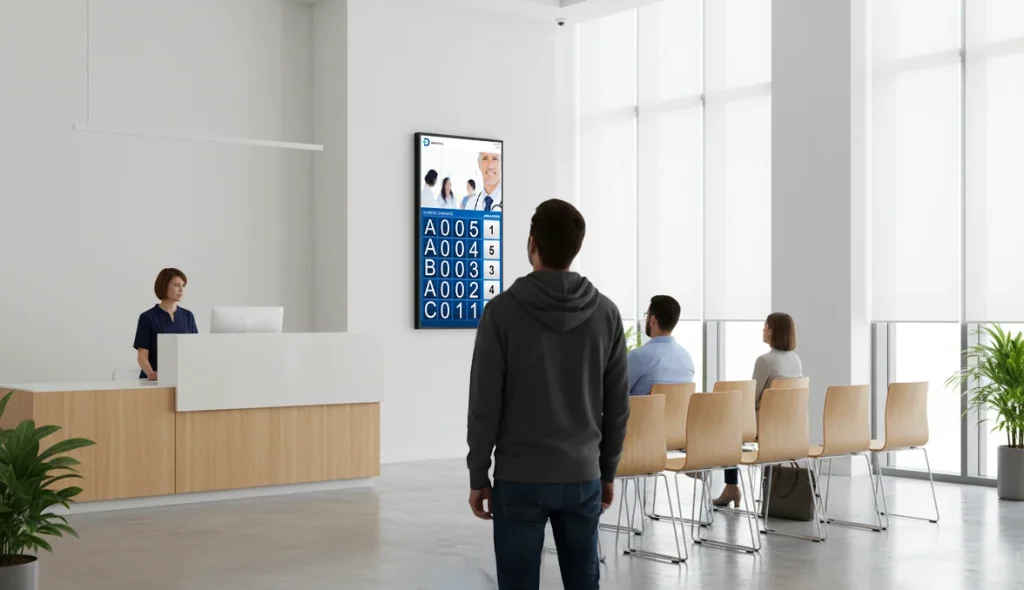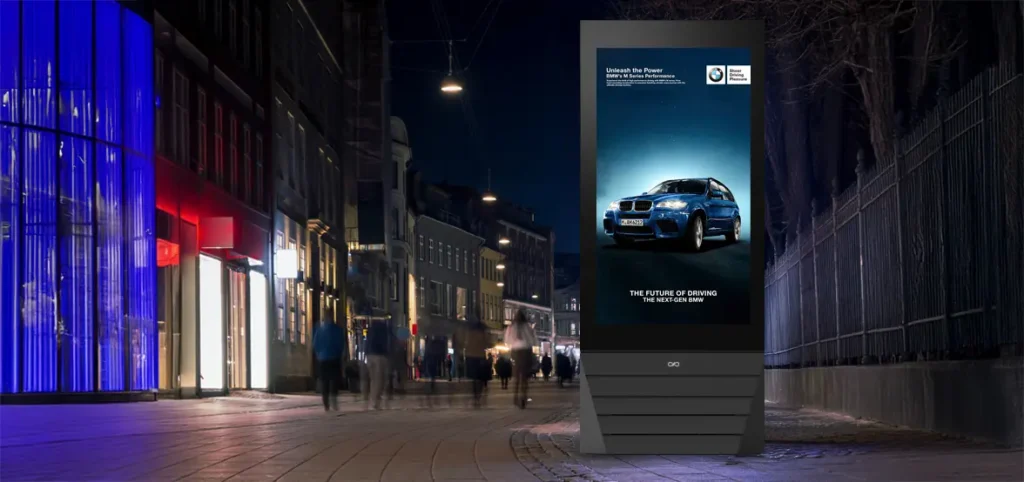
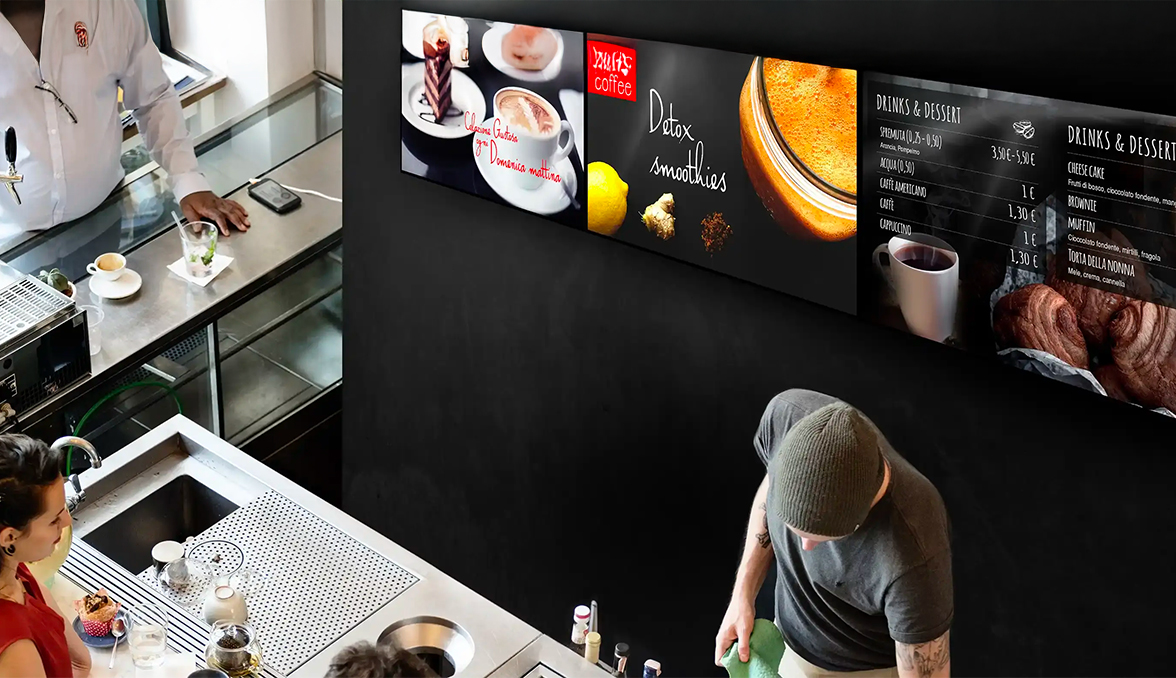
In the contemporary retail landscape, where the customer experience is increasingly driven by visual communication, screens represent a key element of engagement.
However, behind an apparent technical similarity, professional monitors and consumer televisions respond to completely different usage patterns and requirements.
Confusing the two categories means compromising the quality of communication, reducing the lifespan of investments, and, in many cases, generating unexpected management costs, often underestimated in the initial phase.
Professional monitors and consumer TVs: a structural difference
A television is designed for the home environment: a few hours of operation per day, brightness designed for controlled spaces, and a limited life cycle.
Professional monitors, on the other hand, are designed to operate continuously in contexts such as retail outlets, hospitality, and corporate environments.
A first distinguishing feature, often overlooked, concerns the operating hours for which the devices are certified.
Consumer televisions are generally designed for an average use of 4–6 hours per day, while professional monitors are certified for 16/7 or 24/7, with components and dissipation systems suitable for continuous use.
As also highlighted in the documentation on professional digital signage displays, these certifications are not a technical detail, but a structural difference in the design.
Systematically exceeding the expected usage limits accelerates panel wear, with effects visible already in the first few months of operation.
The differences don’t stop there:
- Continuous operating life, with components designed to function without interruptions.
- Superior brightness and color fidelity, designed for environments with strong natural or artificial lighting.
- Free orientation (horizontal or vertical) without compromising performance or warranty.
- Centralized remote management, integrable with digital signage platforms.
- Professional warranty, which explicitly covers continuous commercial use, unlike consumer TVs.
Seemingly similar, but fundamentally different: using a TV in a retail context can lead to burn-in, firmware crashes, brightness drops, or premature failures—a direct risk to brand image and the customer experience.
Burn-in and static content: a real risk in retail
At the point of sale, displayed content is often repetitive and static: logos, prices, promotions, fixed layouts.
This condition significantly increases the risk of burn-in on panels not designed for professional use.
It’s a phenomenon widely documented by AV industry associations: according to various analyses of burn-in in digital signage displays, the continuous use of static graphic elements accelerates the visual degradation of panels not certified for commercial use.
Professional monitors integrate specific protection systems—such as pixel shifting and advanced backlighting controls—precisely to manage this scenario.
These features, in most cases, are not present in consumer televisions because they are not designed for intensive use.
The hidden cost of “cheaper” choices
An initially cheaper choice can quickly become more expensive in the medium term.
The problem isn’t just replacing hardware, but everything that comes with it: reinstallation, content reconfiguration, operational downtime, and loss of communication effectiveness.
Several studies on the Total Cost of Ownership of technology solutions highlight how the true cost of an IT choice emerges over time, rather than at the time of purchase.
In many cases, the overall cost of an early replacement far exceeds the initial savings achieved by choosing a non-professional solution.
In retail, a dead or malfunctioning screen isn’t a technical detail: it’s a negative message sent to the customer at the moment of greatest attention.
Digital Signage: beyond the screen, you need a plan
An effective digital signage system is not just a collection of installed monitors.
It’s a structured digital communication strategy, designed to enhance content, guide the purchasing journey, and strengthen brand identity.
Several studies on the customer experience at the point of sale show how inconsistent, obsolete, or non-functional visual elements are subconsciously associated with poor attention to detail and low-quality service.
In retail, technology also communicates—for better or for worse.
Proper planning allows you to define:
- where to place the screens to maximize visual impact,
- what content to produce and how often to update it,
- how to integrate communication, architecture, and customer flows.
Field experience makes the difference
In many retail redevelopment projects, we work on installations originally built with consumer televisions, replaced after a few months due to reliability or management issues.
It’s often at this stage that the difference between a technical choice and a strategic choice emerges: when the technology must function every day, invisibly, without creating operational friction.
The strategic role of the technology partner
Choosing the right partner is what transforms an installation into a successful project.
A truly independent partner, free from brand or inventory restrictions, can advise based on the customer’s real needs, not product availability.
Value lies in experience: understanding the language of retail, anticipating critical issues, and coordinating hardware, software, and content consistently and reliably over time.
Experience and vision: the factors that make the difference
Today, technology must enhance the experience, not impose itself on it.
Knowing how to distinguish a professional monitor from a television and relying on a thoughtful digital signage project means protecting your investment and building lasting value for your brand.
We don’t just supply screens. We design digital communication systems designed to work over time, in real retail contexts.
 |
Speak with one of our pecialistsEvery store is unique—your communication should be too. |
|
Speak to one of our specialistsEvery store is unique—your communication should be too.
|