
In most retail, corporate, and healthcare projects, the waiting room is still perceived as a “service” space.
Yet it is often the first place where people stop, observe, orient themselves, and begin to form an idea of the organization before them.
For an architect or interior designer, this means one thing: the waiting room is not just a collection of seats, tables, and finishes, but an environment in which flow, comfort, and technology must be designed together.
In this context, digital queue management systems and digital signage are not technical accessories to be decided upon at the end of the project, but elements to be integrated into the concept from the very first draft.
From “waiting room” to “reception space”
In recent years, design trends in healthcare, offices, and hospitality have clearly evolved: the waiting room is transforming into a space for welcoming, connecting, and, in some cases, working.
We’re moving from identical rows of seats to more flexible configurations, with distinct areas for those who want to work, for families, and for those seeking privacy or greater comfort.
This shift requires a rethinking of flows: how people arrive, where they register, where they sit, how they are called, how they find their destination.
The key question for designers becomes: “How can I make this sequence intuitive, legible, and consistent with the project’s visual identity?”
Three Key Design Constraints for Architects and Interior Designers
When designing a waiting room with a digital queue management system, it’s helpful to consider three main constraints.
- Flows and Wayfinding
The entrance, registration area, waiting area, and call point must follow a clear logic.
The goal is to minimize implicit user questions: “Where should I go?”, “Should I get in line?”, “When is it my turn?” - Comfort and Perception of Time
The choice of seating, lighting, acoustics, and visual content directly affects the perception of waiting.
Clear and consistent communication during wait times helps reduce the negative perception of time spent and the level of stress, both for those waiting and for front office staff. - Visual identity and consistent language
Materials, color palette, furnishing style, and the presence of screens or totems must speak the same language.
The queue management totem is also part of this visual grammar: if it is anonymous or out of scale, it introduces dissonance into an otherwise coherent design.
Where the digital queue management system comes into play
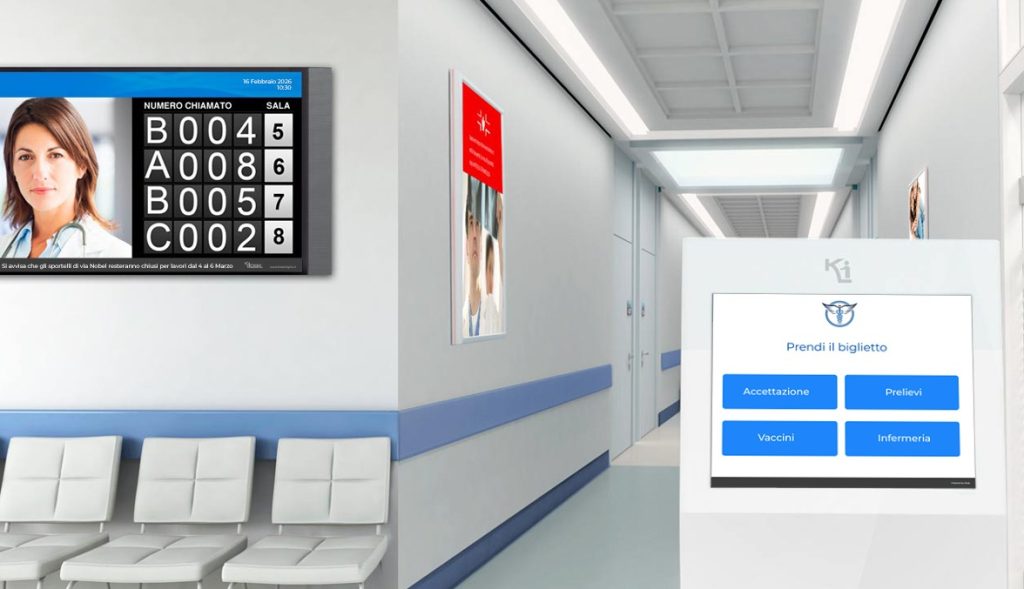
A digital queue management system is not simply a “number dispenser,” but an infrastructure that organizes and makes the relationship between people and service understandable.
For those designing spaces, this means working on some specific aspects.
- Positioning the totem
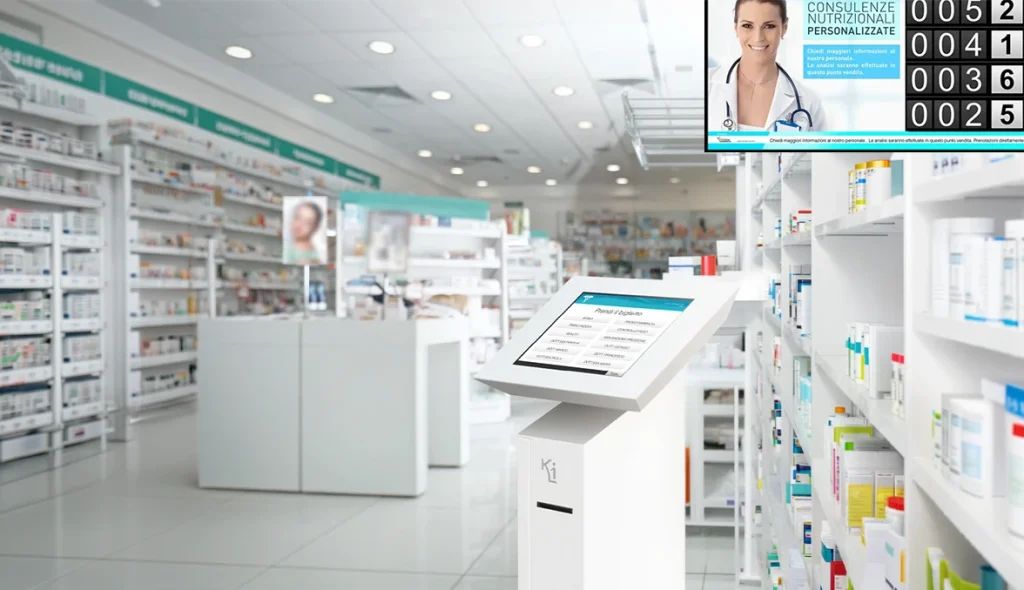
The totem must be visible at the right time: too close to the entrance creates crowding, too hidden generates confusion.
It should be placed in a location where the transition “I enter – I register – I understand where to go” is natural and does not require additional explanations. - Readability and accessibility
Reading heights, viewing angles, any touch interaction, and the placement of call screens must be sized based on the context (large waiting room, corridor, open space).
It is important to consider users with reduced mobility, elderly people, and crowded environments where lines of sight can be easily obstructed. - Reducing perceived chaos
A well-integrated queue management system reduces improvised lines, crowded counters, and repetitive questions to staff (“Who’s last?”, “Is it my turn?”).
The waiting room appears more orderly, comprehensible, and consistent with the image of a structured organization.
The role of Kiosk Hydra as the “invisible director” of the waiting room
From a technological standpoint, the heart of a project is the software platform that governs the queue management system.
Solutions like Kiosk Hydra allow you to:
- manage simple or multi-service queues;
- assign priorities (e.g., dedicated counters, fast-track routes, protected categories);
- integrate multiple reception points and waiting rooms into a single control room;
- collect data on wait times and counter loads.
In an architectural project, this translates into the ability to think of the waiting room as a hub of a larger system: not just “here we distribute numbers,” but “here we orchestrate the entire flow of people and services.”
When Kiosk Hydra is integrated with dedicated digital signage software, the waiting room becomes an environment where queue management and visual communication work together in a coordinated manner.
Integrating queue management systems and digital signage in the waiting room
The integration of queue management systems and digital signage allows you to transform the wait into an informative and, in some cases, brand-building experience.
- Queue management screens
Monitors can clearly display the queue status, the number called, the relevant counter, and any directions.
The design must consider lines of sight, reflections, ambient brightness, and reading distance. - Informative and contextual content
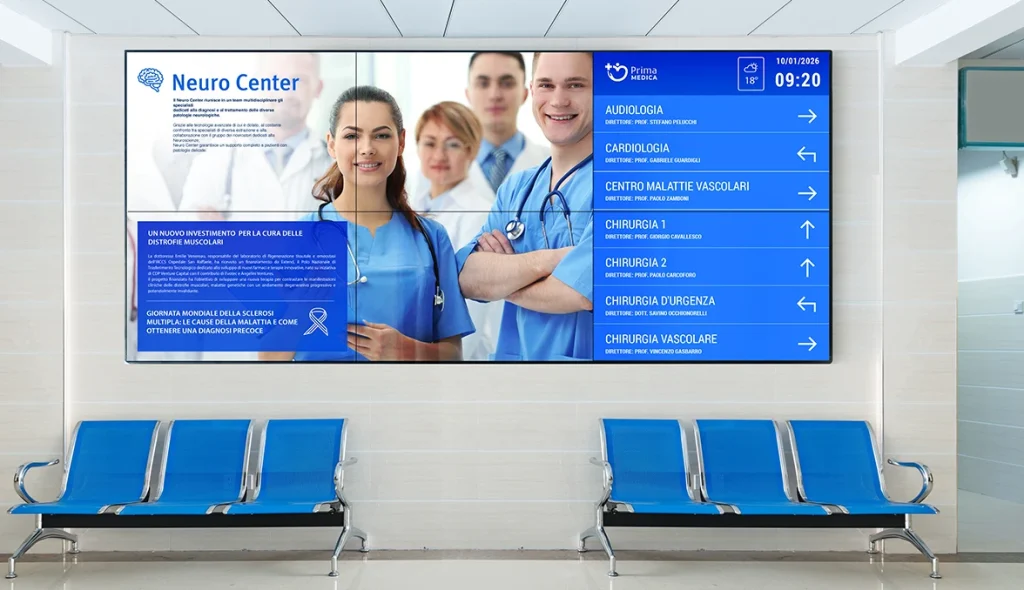
Apart from calls, screens can convey informative, educational, or brand content: service instructions, practical advice, prevention campaigns (in healthcare), and additional services (in retail or corporate).
In this scenario, dedicated digital signage software becomes part of the infrastructure, allowing you to manage schedules, layouts, and content differentiation by time slots or waiting areas. - Consistency with the architectural concept
Frames, supports, wall-mounted installations, or custom-made structures can conceal wiring and transform screens and totems into integrated architectural elements, not simply devices “placed” or positioned near the most convenient power outlet.
Practical Guidelines for Design Firms
To implement a queue management system during the concept phase, a small design checklist can be useful:
- Plan the registration point (totem), the position of the call screens, and the sight lines from the waiting area from the outset.
- Define the dimensions, dimensions, power supply, and network in the system layouts, avoiding makeshift solutions at an advanced stage.
- Evaluate the totem’s impact on flow and comfort: distance from entrances, paths, seating, and any privacy zones.
- Coordinate the totem’s materials and colors with those in the project (RAL, metal finishes, lighting elements), so as to make it a visual reference consistent with the brand.
- Consider future integration with other interactive kiosks and digital engagement points where the project allows (e.g., retail, corporate, museums).
Why involve the queue management system supplier in the preliminary phases
From the designer’s perspective, involving a partner specialized in digital queue management systems in the preliminary phases means reducing risks and unforeseen issues during the construction and start-up phases.
Kiosk can provide:
- Technical data sheets and models of the totems to be integrated into the tables, such as Kiosk One Small or Kiosk Elegant
- Information on dimensions, mounting points, cable routing, and power/network requirements;
- Guidelines for pairing Kiosk Hydra with totems, screens, and digital signage software for managing content in the waiting room.
For the contractor and the end customer, this translates into a system that works immediately, without improvised adjustments, with A clear user experience for people and consistent with the architectural design.
A proposal dedicated to firms and contractors
If you’re working on projects that include strategic waiting rooms—in healthcare, corporate, retail, or hospitality settings—integrating a specially designed queue management system and digital signage can make the difference between a space that “manages queues” and one that welcomes, orients, and reassures.
Kiosk can assist architecture firms, interior designers, and general contractors in defining:
- positioning and type of queue management totem best suited to the context;
- layout and sight lines for screens and information content;
- technical specifications and materials for architectural integration.
 |
Are you working on a waiting room project?Schedule a call with one of our Kiosk specialists: we’ll analyze your project together and help you choose the hardware, software, and configuration best suited to your needs. |
|
You are working on a hall project Waiting?Schedule a call with one of our Kiosk specialists: we’ll analyze your project together and help you choose the hardware, software, and configuration best suited to your needs.
|