
Many companies still manage visitor reception with paper records, internal phone calls, and manual processes.
But this approach today creates operational inefficiencies, GDPR compliance risks, and a first impression that is inconsistent with the organization’s image.
Digital visitor management is becoming a standard in modern companies precisely because it transforms the reception area into an organized, secure, and measurable system.
When the reception area becomes a bottleneck
It’s 9:00 a.m.
The day has just begun, and three people are already waiting at the reception desk.
One is filling out the usual paper form.
Another is asking where to leave a photocopy of the document.
The receptionist tries to simultaneously call two extensions, answer the phone, and keep the attendance register updated.
It’s a scene that repeats itself every day in thousands of Italian companies. And every day costs time, energy, and—often—creates a less-than-positive first impression on the newly arrived guest.
The reception desk is the first physical touchpoint between your organization and the outside world.
It’s the point where suppliers, customers, partners, and guests form their initial perception of the company.
Yet, in many organizations, this critical point in the process is still managed with tools developed decades ago: sheets of paper, pens, internal phone calls, and manual logs.
The result is a combination of:
- wait times
- incomplete information
- poorly traceable processes
- perception of disorganization
In other words: an experience that doesn’t quite fit the image of a modern company.
The hidden cost of an analog reception desk
When we think about business efficiency, we rarely think about the reception desk.
Yet the numbers tell a different story.
Imagine a company with 50 visitors per day.
If each check-in requires an average of 4 minutes of manual management, that means over 3 hours of daily administrative work dedicated solely to registering visitors.
Time that staff could dedicate to higher-value activities.
But the problem isn’t just time.
Manual management also leads to:
- errors in data entry
- incomplete privacy forms
- difficulty in tracking access
- inability to analyze visitor flows
And then there’s the image factor.
A guest arriving at your location for the first time brings with them specific expectations.
If they find a chaotic reception area, scattered forms, and a staff under pressure, that perception transfers—often unconsciously—to the entire organization.
GDPR and visitors: an often underestimated risk
Since 2018, the European Data Protection Regulation also imposes precise rules on the management of company visitor information. Collecting name, surname, identity document and purpose of the visit — without a structured consent and secure storage process — exposes the company to real risks.
The paper register of visitors, however familiar, is a tool that hardly complies with the GDPR requirements: anyone can read the data of those who came before, there is no automatic deadline for cancellation, there is no digital trace of signed consent.
A digital visitor management system allows you to:
- collect data in a structured way
- acquire consent in digital form
- automatically manage data storage and deletion
- maintain a secure and traceable history of accesses
Rethinking the reception as a flow management system
In our design experience, the issue at the front desk is rarely the number of visitors.
The real problem is the absence of a structured entry management process.
The reception is not simply a welcome point.
It is the initial node of the flows of people within the organization.
When this node works well:
- Access is quick
- the guest is oriented immediately
- internal staff are notified in real time
- the company has a clear vision of access
And it is precisely from this need that digital visitor management was born.
→ If you want to understand how a modern reception system works, learn more by reading our guide on digital registration of visitors in the company
How a digital check-in system works
A digital visitor management system simplifies the entry process, making it quick and autonomous.
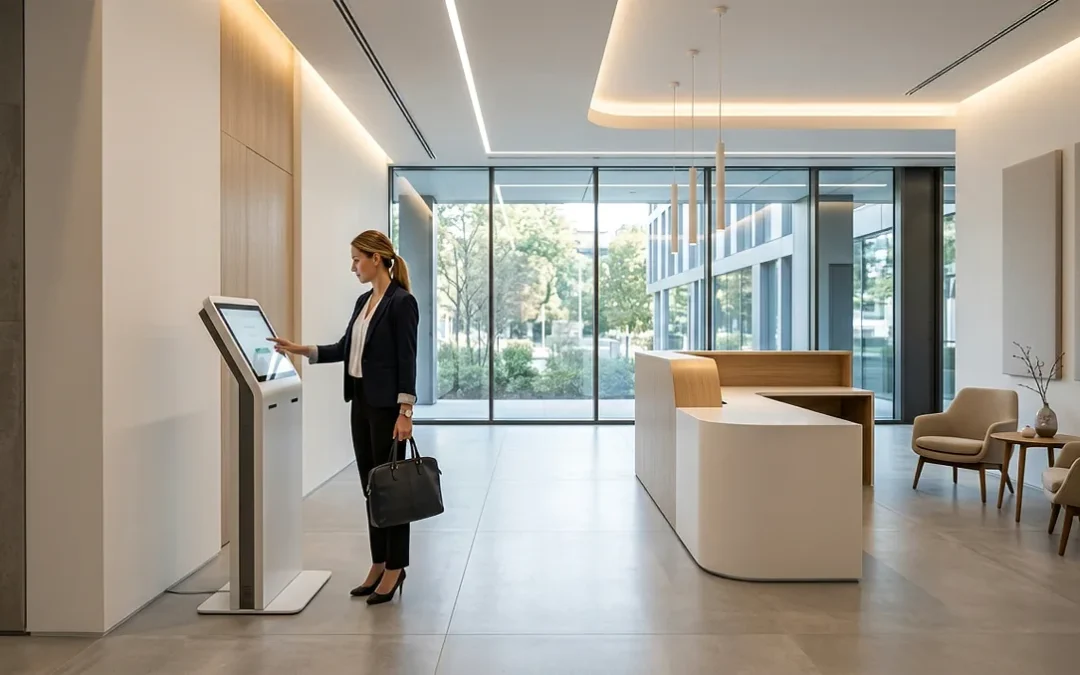
Upon arrival at the company the visitor can register directly on a touch screen totem.
The typical process involves a few steps:
- entering personal data
- selection of the person to meet
- digital signature of the privacy policy
- automatic printing of the access badge
At the same time, the host receives an immediate notification on their smartphone or computer.
The entire process takes less than a minute.
Reception staff can thus focus on welcoming and providing assistance, rather than managing forms and registers.
Varco Kiosk: visitor management designed for your context
Varco Kiosk is the visitor management solution developed by Kiosk to transform company entrance management into a complete digital experience.
It’s not simply a matter of installing a totem.
Every Varco project begins with a phase of analysis and strategic consulting that allows us to understand:
- actual visitor flows
- operational needs of the reception area
- the organization’s security policies
- the communication objectives of the space
The result is a custom-designed system, capable of integrating with the company’s existing tools.
Key features include:
- Touchscreen kiosk for self-check-in
- Reading and approval of safety regulations
- Automatic printing of personalized badges
- Immediate notification to the host
- Digital signature of the GDPR privacy policy
- Access analysis dashboard
- Multi-site management
The system can also integrate with access control systems, company calendars, and CRM.
Where digital visitor management really makes a difference
A visitor management system is useful in any context with a regular flow of external visitors.
For example:
- Corporate companies and headquarters with high volumes of visitors, partners, and suppliers.
- Industrial and manufacturing groups where secure access is a fundamental requirement.
- Hotels and accommodation facilities for self-check-in of guests and management of services.
- Healthcare facilities and medical centers where privacy and traceability are critical.
- Public administration where regulatory compliance is essential.
- University campuses and research centers with complex flows of students, faculty, and visitors.
Is your reception ready for digital management?
If you’re reading this article, it’s likely that your organization’s visitor management is still partially manual.
Often, the problem isn’t obvious until you notice a few signs:
- The reception desk must manage the phone, registers, and visitors simultaneously
- There’s no clear system for tracking arrivals and departures
- Privacy forms are still paper-based
- Guests have to wait while someone tries to contact the person they’re supposed to meet
- There’s no overview of visitor flows across different company locations>
When these signs add up, the reception desk becomes a point of friction in the organization’s processes.
And this is precisely where the value of a visitor management system designed around the company’s real-world context comes from.
Conclusion: The reception is your business card
Visitor management isn’t an administrative issue. It’s a matter of image, security, regulatory compliance, and operational efficiency.
Digitizing the check-in process doesn’t mean eliminating the human factor from reception—it means freeing people from repetitive tasks to focus on what really matters: making every guest feel expected, welcomed, and valued.
Frequently asked questions about digital visitor management
How long does it take to implement a system like Kiosk Varco?
It depends on the complexity of the context and the integrations required. On average, 4-8 weeks pass from the analysis phase to operational installation.
Does the system also work for repeat visitors?
Yes. Varco allows you to recognize previously registered visitors and further speed up the check-in process for frequent visitors.
Is it necessary to have in-house technical staff to manage it?
No. Kiosk takes care of installation, training, and ongoing support. Day-to-day management is designed to be autonomous and intuitive.
What happens if the kiosk stops working?
The system includes backup options, and the Kiosk support team is available for both remote and on-site technical assistance.
Can the interface be customized with your company branding?
Absolutely yes. The kiosk interface is designed to match your organization’s visual identity.
Does a visitor management system also help with GDPR?
Yes. A digital visitor management system helps collect visitor data in a structured way, manage privacy consent digitally, and improve the traceability, retention, and control of information compared to paper records.

Don’t wait any longer!
Book a free discovery session with the Kiosk team. In 30 minutes, we’ll analyze your workflows together and show you how Varco can work for you.