

We’ve seen how, already in 2025 (and increasingly in 2026), lead generation has progressively abandoned approaches based on interruptions, cold calls, and aggressive campaigns.
New contact acquisition has instead shifted toward models based on content marketing, capable of building value, trust, and relationships even before the sale.
According to the latest industry analyses, approximately 3 out of 4 marketers say they use content as the primary lever for generating leads, with significantly greater efficiency than traditional outbound methods.
This shift reflects a profound transformation in the way people search for, evaluate, and choose suppliers and solutions.
According to industry analyses on B2B marketing, leads generated through content marketing cost on average up to 60–65% less than those acquired through outbound activities, while maintaining a higher level of qualification throughout the funnel.
It’s not just about generating more leads, but about generating better leads, with a direct impact on ROI and the sales cycle.
Why content marketing is central to lead generation
Content marketing for lead generation works because it intercepts potential customers in the early stages of the buyer’s journey, when they are still gathering information.
At this stage, the user:
- is not ready to speak to a salesperson,
- is not looking for a quote,
- wants to understand the problem and possible solutions.
Inbound marketing therefore shifts the focus from “selling now” to building trust and authority.
The result is more sustainable lead generation, based on:
- more qualified leads,
- lower acquisition costs,
- smoother sales processes.
B2B Content Marketing and Lead Generation: What Marketers Do Today
Today, approximately 75% of content marketers use content marketing with the explicit goal of generating leads, with an even higher penetration in B2B.
A particularly significant figure concerns investments: for many teams, over 40% of the digital budget is allocated to lead generation activities, with content and contact acquisition being managed as a single integrated process.
This marks the definitive shift:
👉 from content as a showcase to content as a MQL (Marketing Qualified Lead) generator.
Not all content has the same impact on lead generation.
The most effective formats for moving users from the awareness stage to consideration are:
- SEO-optimized blog posts,
- podcasts,
- videos.
This content is:
- easily accessible,
- minimally invasive,
- problem-oriented,
- ideal for building an initial relationship.
Case studies and white papers remain useful tools, but they are less effective for engaging new contacts because they require a more advanced level of interest.
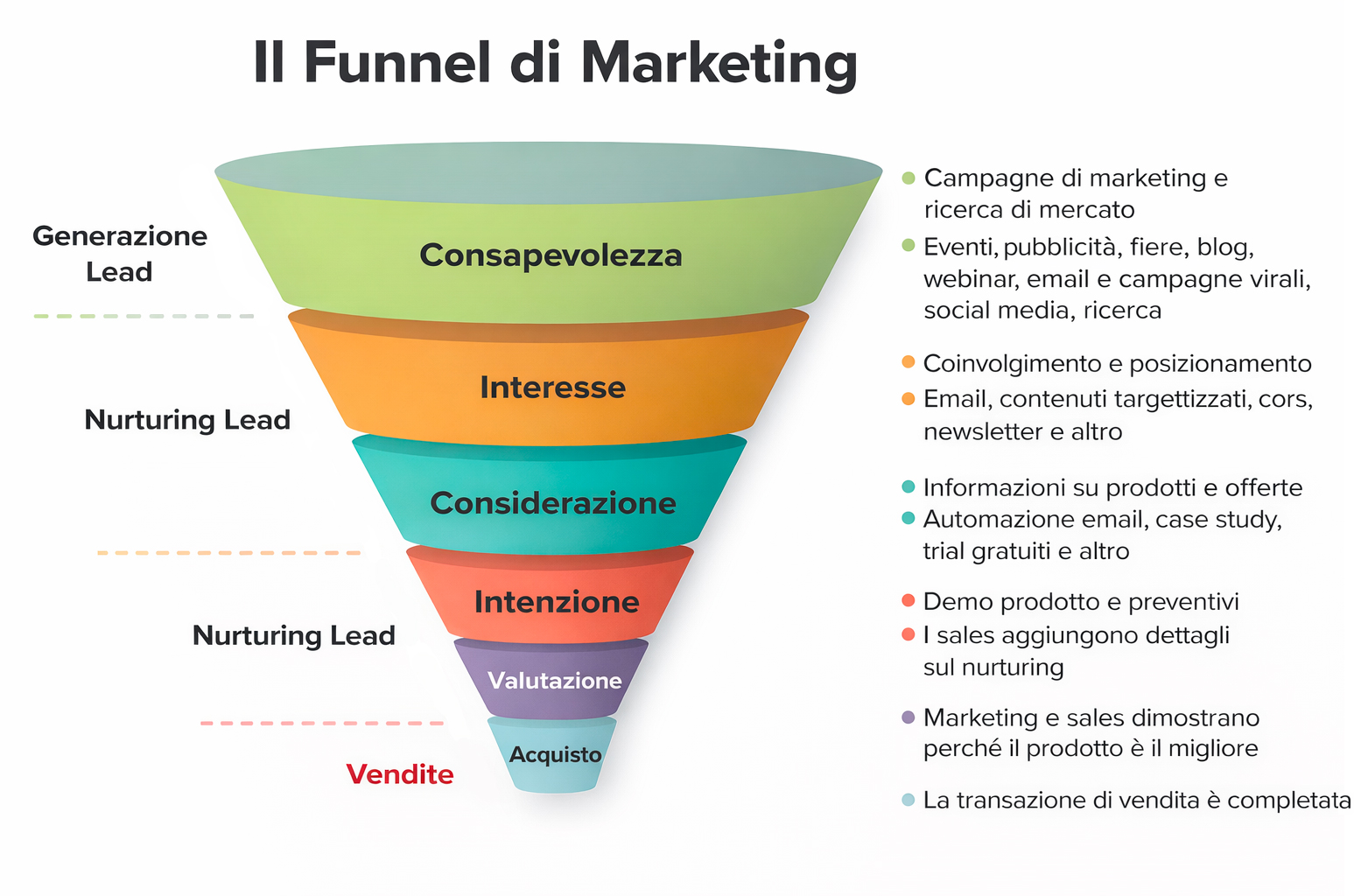
Where the true value is created in lead generation
Most professionals agree on one key point:
👉 the maximum value of content marketing is concentrated in the initial stages of the purchasing journey.
The most strategic content is that which:
- increases awareness
- helps define the problem,
- generates interest,
- prepares the groundwork for contact.
When the user is “ready-to-buy,” informational content loses its centrality, and the following take over:
- nurturing,
- sales process,
- value proposition,
- overall experience.
How to Turn Content into Qualified Leads
To truly work, B2B lead generation must start with content designed with a clear objective: guiding the user from information to qualified contact.
Practical examples in other sectors:
- Article on HR process optimization → Downloadable checklist to evaluate recruiting efficiency,
- Content on corporate cybersecurity → Free risk assessment or self-assessment questionnaire,
- In-depth analysis of marketing and data analysis → Template or dashboard connected to a CRM like HubSpot to track, segment, and nurture leads.
In all cases, the principle is the same:
- The content addresses a real problem,
- The resource makes it concrete and measurable,
- The CRM system transforms interest into a relationship.
In conclusion
According to consolidated B2B marketing analyses, companies that adopt a structured inbound marketing strategy generate on average up to 3 times more leads than those who primarily use outbound approaches, with a significantly lower cost per lead and a higher conversion rate along the funnel.
The real advantage lies not in the tool, but in the strategy with which content, data, and processes are integrated.
Transforming content into qualified leads requires method, not improvisation.
As a HubSpot partner, we support companies in designing inbound marketing strategies that integrate content, SEO, CRM, and sales processes, with the goal of generating truly qualified and measurable leads over time.
If you’d like to understand how to apply this approach to your business, you can schedule a consultation call: an initial consultation to analyze your current scenario and evaluate growth opportunities through inbound marketing.
 |
Let’s talk about itBook a call to understand how to design a lead generation system based on content, data and CRM. |
|
Let’s talk about itBook a call for Understand how to design a lead generation system based on content, data, and CRM.
|