
In Italy, allowing a visitor into a company without having them read and sign anything isn’t just an organizational flaw: it’s a concrete regulatory risk. The GDPR, Legislative Decree 81/2008, and—in many cases—internal company regulations impose specific obligations that apply to anyone who enters the door: customers, suppliers, external technicians, maintenance workers, interview candidates.
The problem is that few know exactly what documents are required, and even fewer have a system that automatically, traceably, and paperlessly signs them. Meanwhile, the same thing happens every day in Italian reception areas: a visitor arrives, the receptionist asks them to write their name and time on a paper register, and then lets them take their seat.
No signed information. No proof, in the event of an inspection or incident, that the company has done its part.
What the law says: mandatory documents for visitors
Before discussing tools, it’s helpful to understand the regulatory framework. There are at least three areas in which the company has specific obligations towards those who enter—even if it’s just a short visit.
1. Privacy Policy (GDPR, EU Regulation 2016/679)
When a visitor checks in at the reception desk, the company collects personal data: name, surname, ID, entry and exit times, and vehicle license plate (if applicable). This is the processing of personal data in all respects.
The GDPR requires the company to provide clear information before or at the time of data collection, specifying who is the data controller, the purpose for which the data is collected, how long it is retained, and the data subject’s rights.
Having this information signed at the check-in kiosk isn’t a formality: it’s a requirement. And a digital signature with a timestamp is much more solid proof than a paper document that ends up in a drawer.
2. Safety information (Legislative Decree 81/2008)
This is the most surprising point. The Consolidated Law on Safety at Work does not only concern employees: Article 26 requires the employer to provide information on specific risks in the environment to self-employed workers and anyone entering company premises to carry out work.
In practice: if an external technician enters a warehouse where forklifts are used, or a laboratory where chemicals are used, or even just an office with hidden emergency exits, the company must inform them of the risks and safety measures to be taken.
This information—often called a simplified DUVRI or access document—must be delivered and, ideally, signed for acknowledgement. In the event of an accident or an inspection by INAIL or the Labor Inspectorate, its absence can be costly.
3. Internal regulations and confidentiality agreements
Beyond legal requirements, many companies require visitors to accept certain rules before entering:
- Prohibition of photography or filming of production areas, showrooms, and warehouses
- Mandatory use of PPE (personal protective equipment) in certain areas
- NDA or confidentiality agreement for those accessing R&D areas, prototypes, or production environments, meeting rooms with confidential information, or areas where sensitive customer data is processed
Even a brief set of rules signed by the visitor can make a difference in the event of a dispute.
In summary: what each visitor must sign
A digital signature acquired on a kiosk or touch tablet has full legal validity when associated with a certified timestamp and archived in a traceable manner—with greater evidentiary value than a paper signature on a loose sheet of paper.
The Problem with paper records
The paper record—or the pen record—has two fundamental limitations that are often underestimated.
The first is traceability: a sheet of paper can get lost, become illegible, or not be archived properly. If the labor inspector or DPO asks for proof that the visitor of March 14th received the safety information, finding that sheet among dozens of others is far from certain.
If you’re considering going digital, also read how to digitize your company reception.
The second is certainty of content: on a paper record, the visitor signs without necessarily having read anything. There’s no way to know whether they actually read the information or simply signed in vain.
How the check-in flow with Kiosk Varco works
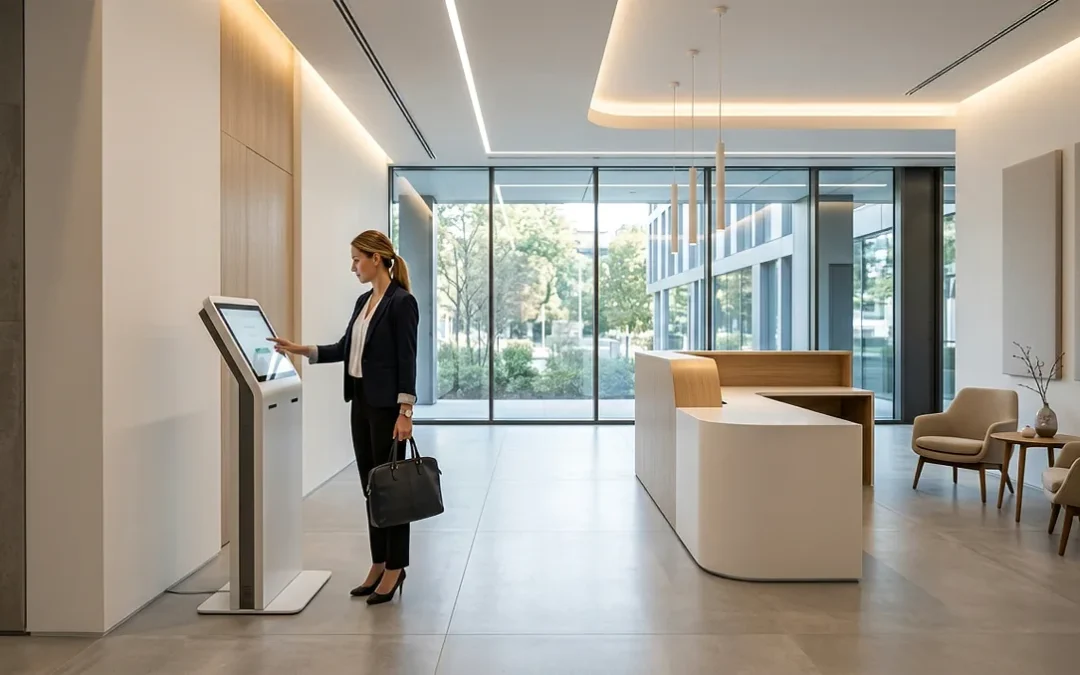
Kiosk Varco manages visitor check-in via a touch screen kiosk or tablet at the reception desk. The flow can be configured to include, in sequence, all the documents that the visitor must read and accept before receiving their access badge.
In practice, it works like this: the visitor approaches the kiosk, enters their name and surname (or scans a document), and the system presents one or more screens with the texts the company has uploaded—privacy policy, security policy, internal regulations. The visitor can scroll through the text and only proceed with signing after reaching the bottom of the page.
The signature is captured directly on the touch screen, associated with the visitor’s name, date, and exact time. Everything is digitally archived and accessible at any time.
The result is that every visit automatically generates a complete record: who entered, when, which documents they read, and who signed for acknowledgement. No paper, no manual archiving, no margin for error.
A concrete example: 750 accesses per month, zero paper — food sector case study.
What can be configured in Kiosk Varco
From an operational standpoint, the administrator can upload any text they want to the system and update it at any time—without having to intervene with the software. If the company updates its internal regulations or renews its privacy policy, simply replace the document and all visitors will see the updated version from the following day.
Different documents can be configured based on the type of visitor (supplier, customer, technician, interview candidate) or the company area they need to access. A visitor going to the sales office sees a different flow than someone entering the warehouse.
An investment that pays off in the first inspection
It’s difficult to quantify the value of well-managed compliance until something happens. But all it takes is a single complaint from the Labor Inspectorate, an incident requiring proof that the visitor was informed, or an audit request from an enterprise client seeking to verify safety procedures, to understand the importance of having—or not having—that documentation.
Kiosk Varco isn’t just a system for tracking who enters and exits. It’s a tool that transforms the reception area into an automatic compliance hub: every visit is documented, every signature is archived, every regulatory requirement is fulfilled without anyone having to remember it every day.
Registering company visitors isn’t a formality: it’s a regulatory requirement regarding privacy, workplace safety, and the company’s legal protection. Paper registers offer neither the traceability nor the certainty of content that an inspection or incident might require.
There are two questions to ask yourself today: does the system you’re using allow you to demonstrate, at any time, that each visitor has received and signed the privacy policy? And the security policy?
If the answer is no—or “maybe, if we find the paper”—discover how Kiosk Varco works.

Want to learn more?
Book a free demo.